
H.E.S.S. CollaborationH.E.S.S. Collaboration
  • About H.E.S.S.
    • H.E.S.S. Collaboration
      • Organisation
    • H.E.S.S. Science
    • H.E.S.S. Telescopes
    • H.E.S.S. Prize
  • News
    • Announcements
    • Press releases
    • Archival news
  • Source of the month
  • For scientists
    • Publications
      • Journals
      • Conferences
      • Astronomers Telegram
    • External Proposals
      • Visibility calculator
    • GRB observation schedule
    • Public test data release
    • Telescope specifications
  • Contact

Author Archives: H.E.S.S. Collaboration

June 1, 2020 by H.E.S.S. Collaboration
Source of the Month

SGR J1935+2154: An active magnetar now linked to repeating fast radio bursts. A new opportunity for H.E.S.S.

June 2020 Magnetars are very highly magnetised neutron stars with a surface magnetic field reaching 1015 Gauss, about 1000x stronger than that derived for ‘normal’ neutron stars, and among the strongest magnetic fields found…
Read more

May 1, 2020 by H.E.S.S. Collaboration
Source of the Month

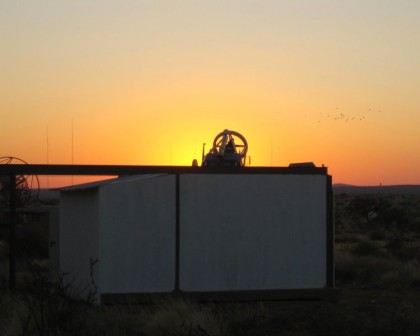
ATOM: A trailer, a trigger and a tug for H.E.S.S.

May 2020 The H.E.S.S. array is a very advanced and efficient observatory for ground-based gamma-ray astronomy, sensitive enough to trace rapid variations in flaring sources on time-scales of minutes. Nonetheless, most gamma-ray sources require…
Read more

April 1, 2020 by H.E.S.S. Collaboration
Source of the Month

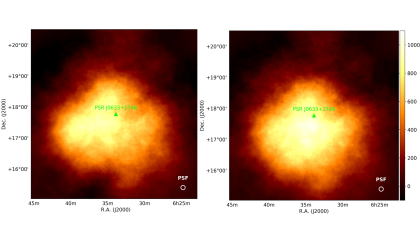
Extended emission around the Geminga pulsar

April 2020 Geminga (Gemini gamma-ray source) was discovered in the early 1970s with the SAS-2 satellite and remained an unidentified gamma-ray source for a very long time. It is now known as a radio-quiet…
Read more

March 1, 2020 by H.E.S.S. Collaboration
Source of the Month

Gamma-ray quasars from the bright to the faint end: PKS 0736+017

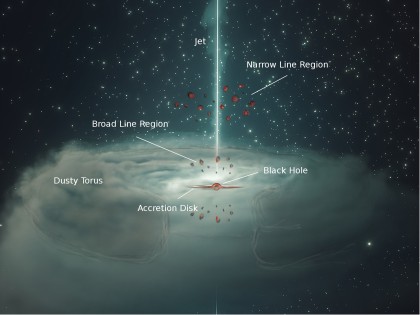
March 2020 About two percent of the hundreds of billions of galaxies in the universe stand out as ‘active galaxies’. A very small nuclear region radiates enormous amounts of light, making Quasars (the most…
Read more

February 1, 2020 by H.E.S.S. Collaboration
Source of the Month

A fresh look at the Galactic Plane

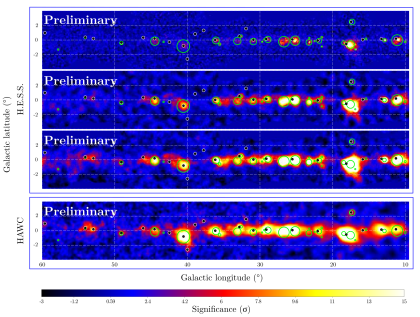
February 2020 The H.E.S.S. Galactic Plane Survey (HGPS,H.E.S.S.-SOM 2016-01) was a 10 year long observation program. For this survey the H.E.S.S. telescopes in Nambia systematically scanned the Milky Way for very high energetic (VHE)…
Read more

January 1, 2020 by H.E.S.S. Collaboration
Source of the Month

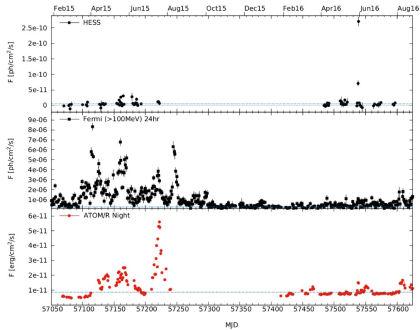
The many-faced quasar PKS 1510-089

January 2020 Among all classes of Active Galactic Nuclei (AGN), the so-called BL Lac objects had been prime candidates for Very High Energy (VHE) gamma-ray emission (Note 1) from the start, as they posses…

Read more

December 1, 2019 by H.E.S.S. Collaboration
Source of the Month

GRB 180720B The First Gamma-Ray Burst Detected in the Very-High-Energy Band

December 2019 After a decade-long search, the H.E.S.S. collaboration has succeeded to detected a gamma-ray burst in very-high-energy gamma light for the first time. This discovery was made in July 2018 using the huge…
Read more

November 1, 2019 by H.E.S.S. Collaboration
Source of the Month

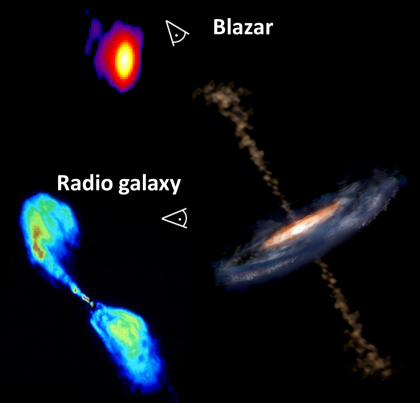
A Gamma-ray view of Radio Galaxies

November 2019 The exploration of the universe at gamma-ray energies resulted in the discovery of ∼200 sources that emit photons of 1 Terra-Volt (1 000 000 000 000 eV) energy [1]. The largest group…
Read more

October 1, 2019 by H.E.S.S. Collaboration
Source of the Month

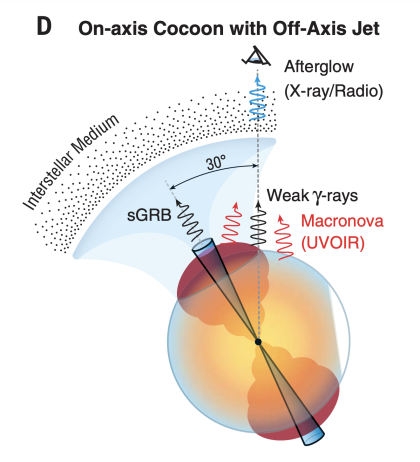
GW170817: Revisiting the site of a binary neutron star merger

October 2019 On August 17th 2017, the detection of the first electromagnetic counterpart to a gravitational-wave (GW) signal was achieved, originating from the binary neutron star (BNS) merger remnant. This result marked the start…
Read more

September 1, 2019 by H.E.S.S. Collaboration
Source of the Month

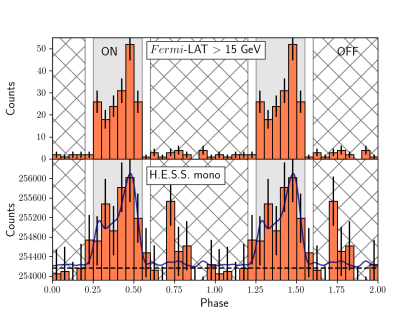
PSR B1706-44: The second pulsar detected by H.E.S.S. in the 10-100 GeV energy range

September 2019 Pulsars Over fifty years ago in 1967, a new type of signal was observed for the first time by radio astronomers [1]. The signal was periodic, remarkably regular, with a peak every…

Read more

Posts pagination

Previous 1 … 4 5 6 … 18 Next
50/175

Browse other months

Recent sources

The Vela Pulsar – the most Highly Energetic ClockNovember 1, 2023
HESS J1645−455 – A gem on the ring?October 1, 2023
The identity crisis of the blazar PKS 1510-089August 1, 2023
Cosmic Conspiracy Theories: Neutrinos and Gamma Rays from PKS 0735+178?July 1, 2023
Flares in the atmosphereJune 1, 2023

Fields

Atmosphere black holes Blazar Cosmic rays Extragalactic Galactic Center galactic plane galactic source Gamma-ray binary gamma-rays neutrinos Nova pulsar

Contact

You can contact us for scientific queries and general information using:
contact.hess@hess-experiment.eu

Data Privacy Statement

https://www.mpi-hd.mpg.de/mpi/de/datenschutzhinweis
H.E.S.S. collaboration official website. Proudly Built By H.E.S.S. members.
(c) 2004-2025 by the H.E.S.S. collaboration

Last sources of the month

The Vela Pulsar – the most Highly Energetic ClockNovember 1, 2023
HESS J1645−455 – A gem on the ring?October 1, 2023
The identity crisis of the blazar PKS 1510-089August 1, 2023

Internal

  • Log in
  • Entries feed
  • Comments feed
  • WordPress.org
H.E.S.S. Collaboration
Manage Consent
To provide the best experiences, we use technologies like cookies to store and/or access device information. Consenting to these technologies will allow us to process data such as browsing behavior or unique IDs on this site. Not consenting or withdrawing consent, may adversely affect certain features and functions.
Functional Always active
The technical storage or access is strictly necessary for the legitimate purpose of enabling the use of a specific service explicitly requested by the subscriber or user, or for the sole purpose of carrying out the transmission of a communication over an electronic communications network.
Preferences
The technical storage or access is necessary for the legitimate purpose of storing preferences that are not requested by the subscriber or user.
Statistics
The technical storage or access that is used exclusively for statistical purposes. The technical storage or access that is used exclusively for anonymous statistical purposes. Without a subpoena, voluntary compliance on the part of your Internet Service Provider, or additional records from a third party, information stored or retrieved for this purpose alone cannot usually be used to identify you.
Marketing
The technical storage or access is required to create user profiles to send advertising, or to track the user on a website or across several websites for similar marketing purposes.
Manage options Manage services Manage {vendor_count} vendors Read more about these purposes
View preferences
{title} {title} {title}