The H.E.S.S. Telescopes

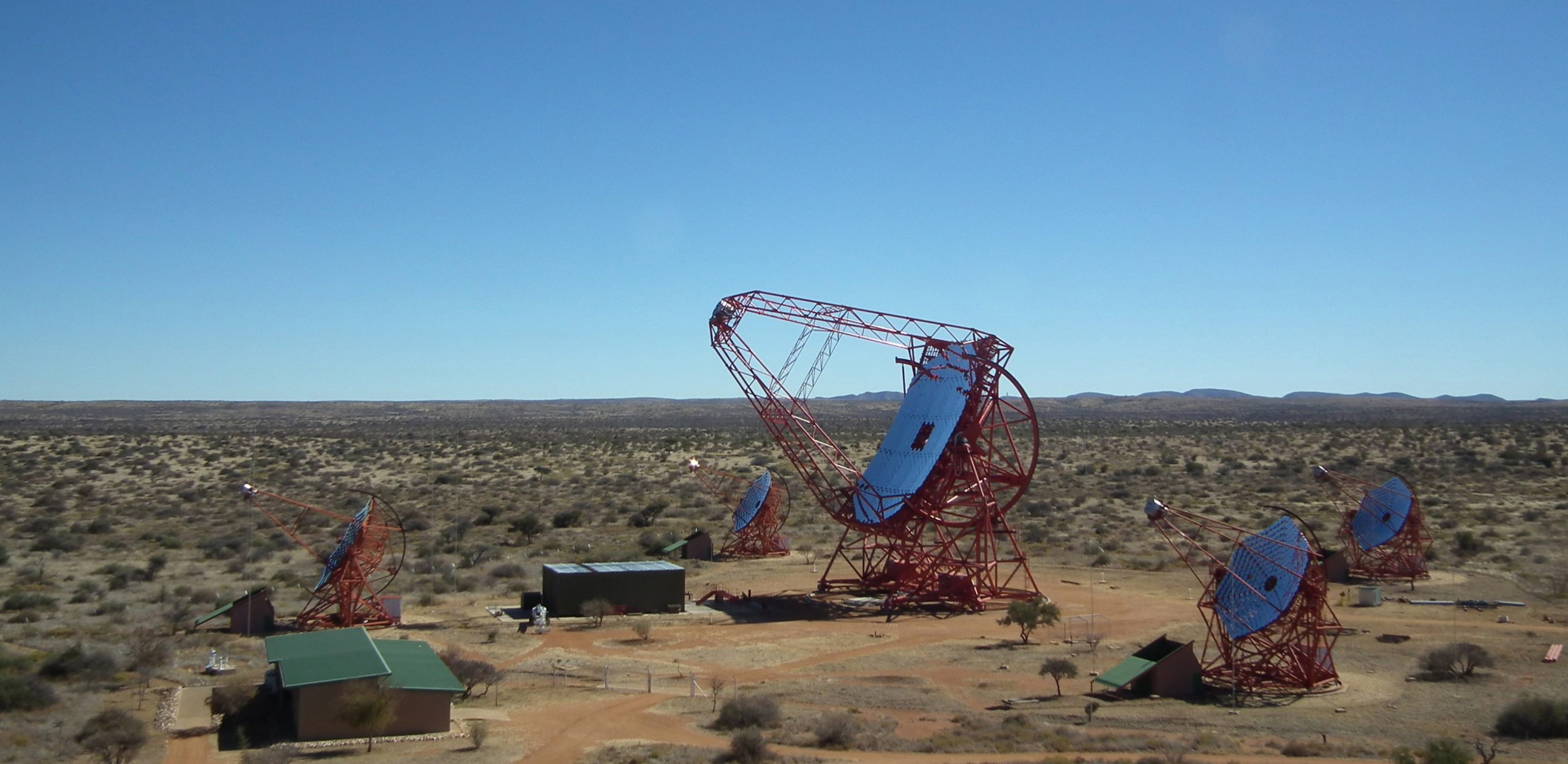
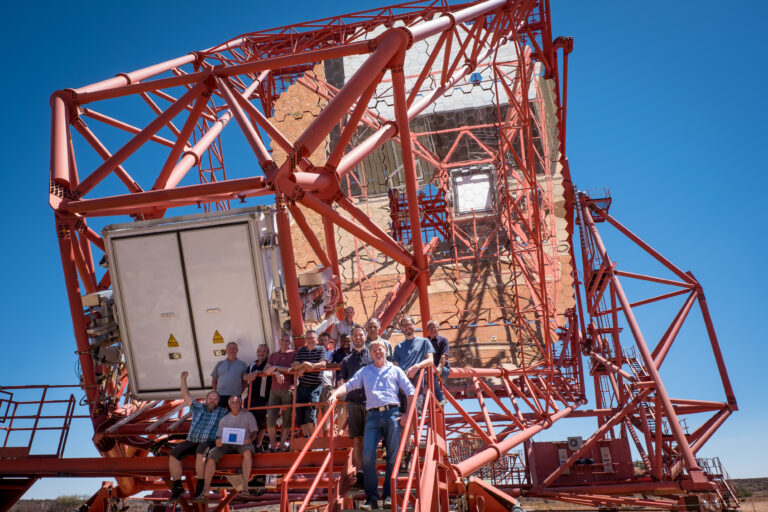
H.E.S.S. is a system of five telescopes that are sensitive to high-energy gamma rays. Together, they simultaneously observe the Southern Sky. To date, it is the only system of its kind that employs telescopes of two different sizes: four 12-meter telescopes, dubbed CT1-4 and installed between 2001 and 2003, are arranged in a square with 120 meter side length. The fifth telescope, CT5, features a 28-meter mirror and is placed at the centre of the array. The use of two different telescope sizes enlarges the sensitive energy range of the system, which is approximately 0.1 – 100 TeV (1 TeV = 1012 electronvolts).

The telescopes are located on Farm Göllschau near Windhoek, Namibia.

The full H.E.S.S. Array in Namibia

The Cherenkov technique

Earth’s atmosphere is opaque to high-energy gamma rays – they can be directly observed only from space, as for example with the Fermi-LAT satellite experiment. However, the collection area of satellite experiments is limited, preventing them from effectively studying gamma rays with energies above ~1 TeV. Gamma rays of higher energies must be studied from the ground, but can only be measured indirectly, as will be explained in what follows.

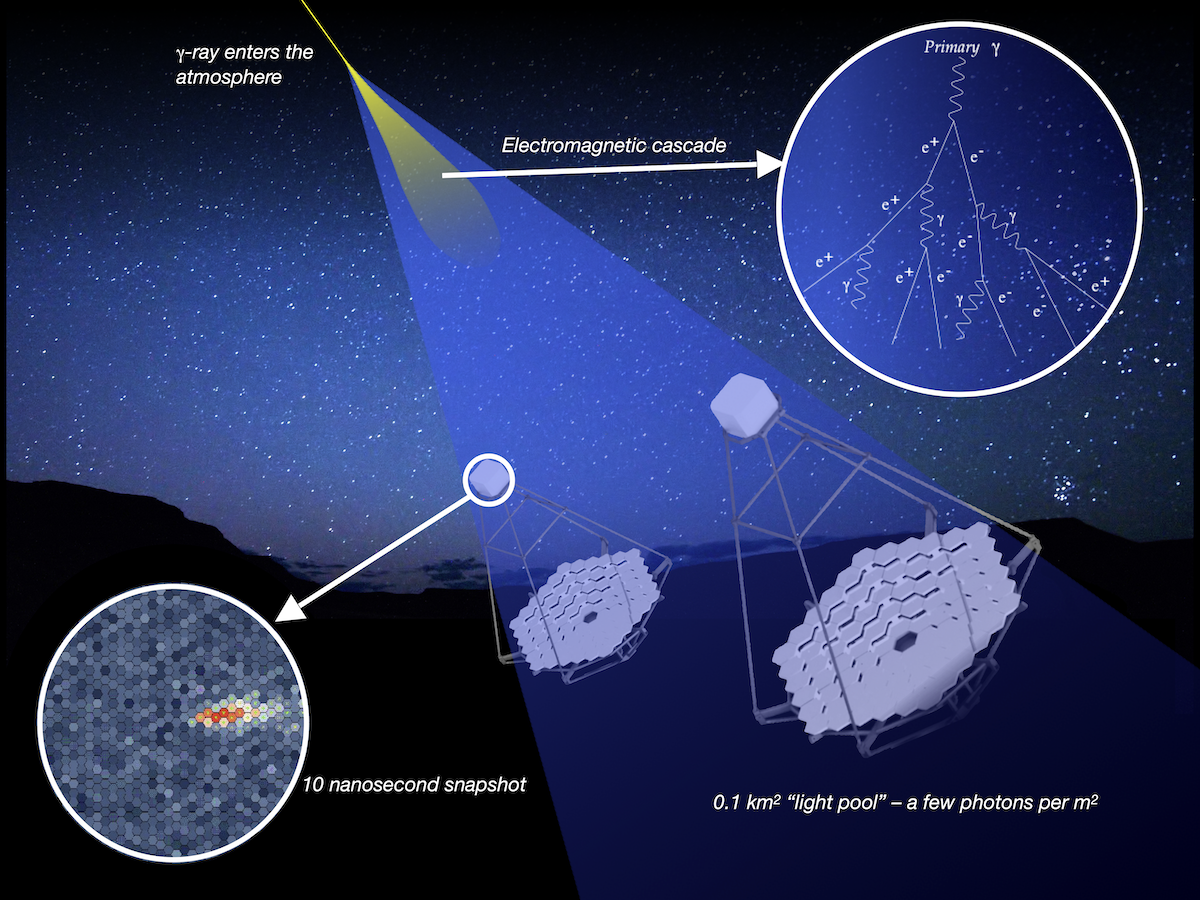
The H.E.S.S. telescopes are imaging atmospheric Cherenkov telescopes, or IACTs. This means that they detect cosmic gamma rays by taking a “picture” of the atmospheric air shower (or particle cascade) that is launched when the high-energy gamma ray interacts with a molecule high up in the atmosphere. This is possible because the secondary particles created in that cascade, travelling faster than the speed of light in air, emit Cherenkov radiation – a few-nanosecond-short, blue flash of light.

A telescope with a large mirror that “collects” enough of these Cherenkov photons and a fast camera that is sensitive to faint light flashes can then produce an image of the air shower, as is illustrated in the sketch.

(Credit: Richard White, MPIK)

The properties of the primary gamma ray can be reconstructed from the shower images. A big boost in reconstruction accuracy can be obtained by observing the same shower with more than one telescope from different angles – this is also what the term “Stereoscopic” in the name of the experiment refers to.

The telescope cameras

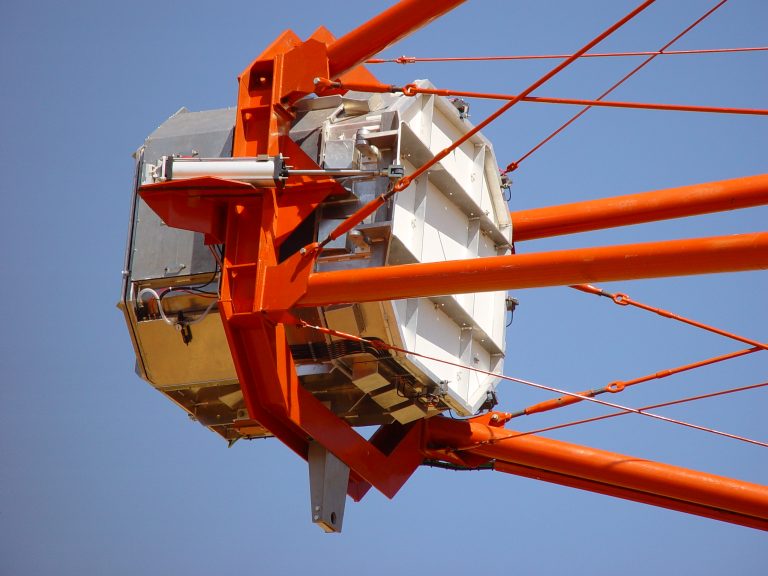
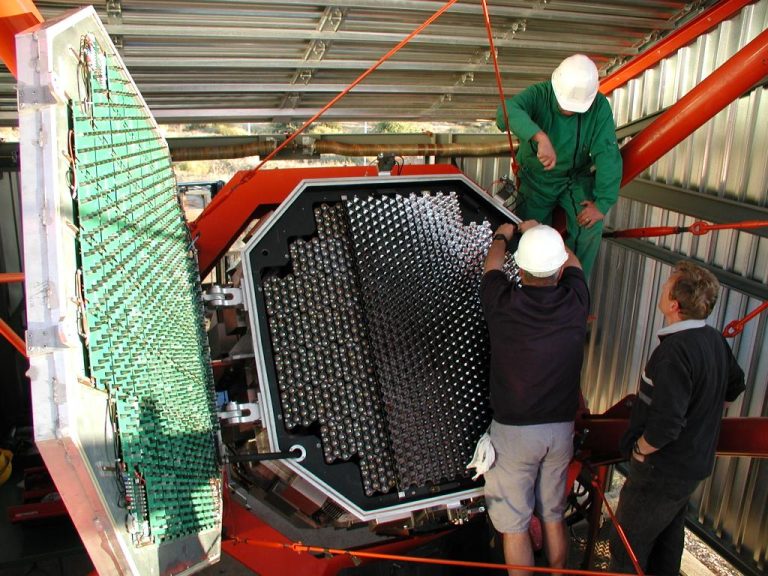
The cameras on the 12-m H.E.S.S. telescopes consist of 960 pixels each, where each pixel is made up of an extremely sensitive light sensor – a photomultiplier tube (PMT) – that can measure single photons. Signals are integrated over exposure times of only 9–16 nanoseconds, to be able to detect the faint flash of Cherenkov light against the night-sky background.

The full camera has a field of view of ~5°, which corresponds to about 10 times the size of the moon. While many gamma-ray sources are smaller than this, the large field of view is very valuable because it allows an estimation of the expected rate of background events from source-free regions.

The picture below shows one of the cameras with its lid opened, during installation.

The PMT signals are captured with a rate of 1 GHz, or one sample every nanosecond. If the signal in several adjacent pixels exceeds a threshold (around 5 photo-electrons per pixel), a camera trigger is issued and sent to a central trigger system. If two or more telescopes provide a simultaneous trigger, the signals are read out, digitised, and stored.

The initial CT5 camera was installed on the telescope until its replacement in October 2019. In its concept, it followed the design of the CT1-4 cameras. However, its dimensions are much larger (227 cm x 240 cm x 184 cm) and it consists of more pixels (2,048 in total).

The camera was capable of recording up to 3,600 images per second. With ~3.6°, the field of view is slightly smaller than that of the CT1-4 cameras. The camera weighed 2.8 tons and had a power consumption of 8 kW.

3D animation of the HESSII camera’s winston cones, Photomultipliers (PMTs) and Front-end electronics trays. (credits : w.si said Laboratoire Leprince Ringuet)

Image credit: Christian Föhr, MPIK

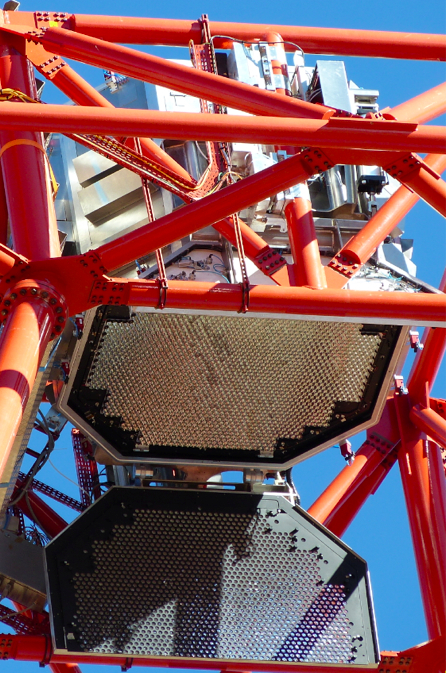
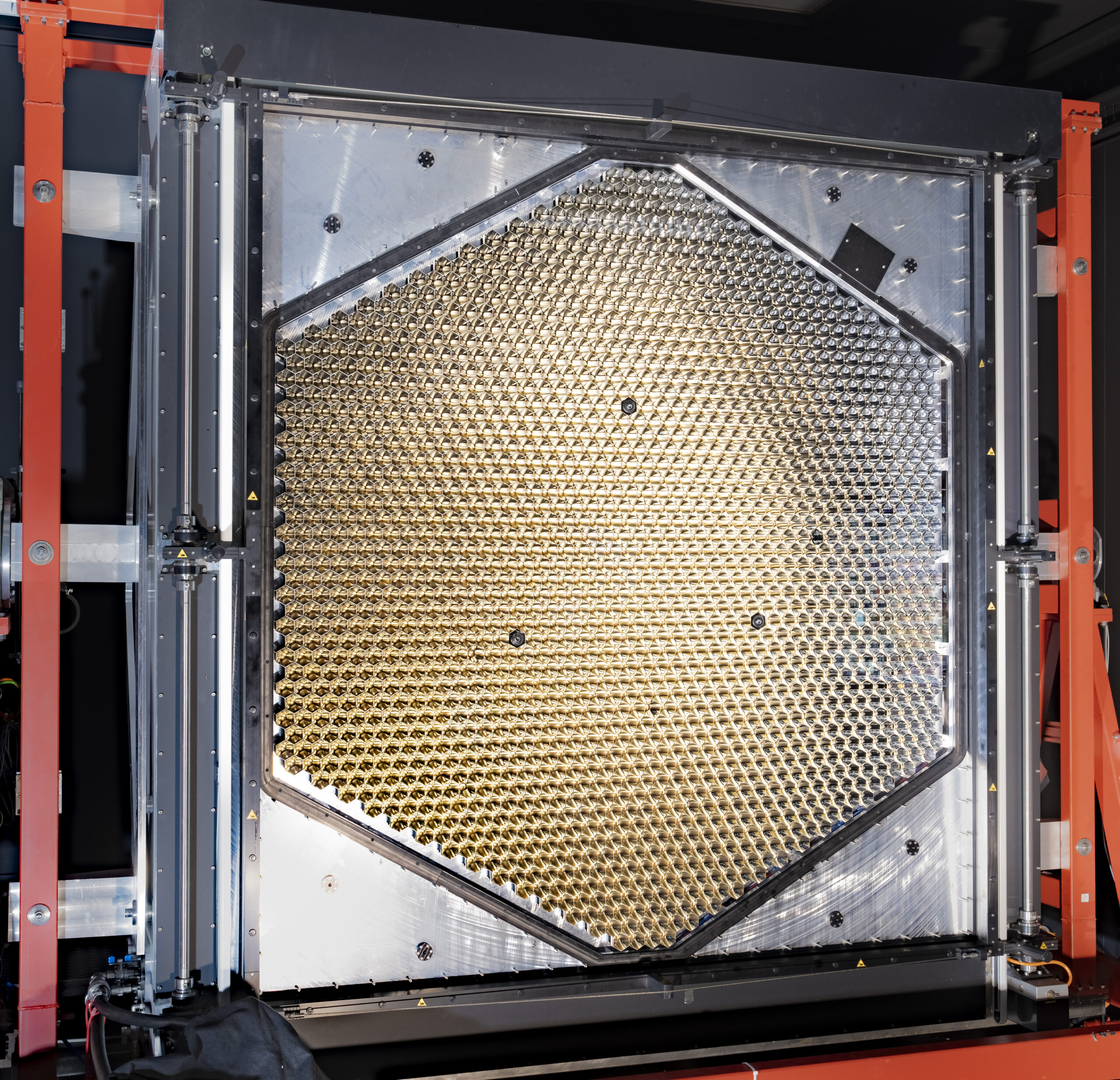
FlashCam is a state-of-the-art camera for ground-based, imaging atmospheric Cherenkov telescopes. It was originally developed for the next-generation observatory, CTAO, for which it is one of the selected cameras for the future southern array. In October 2019 an advanced prototype version was installed in the large 28-m telescope of H.E.S.S. (see also SOM October 2020). Since installation it has been operated with high reliability.

Functional key building blocks of the FlashCam design are the photodetector plane, with an area of almost 4 square meters, and a high-performance, fully digital trigger and readout system. The photodetector plane consists of 147 modules, each containing 12 photomultiplier tubes (PMT) with peak quantum efficiencies above 40%. The analogue signals of the PMTs are digitised continuously with a sampling rate of 250 million samples per second at 12-bit resolution. The data stream of the digitised signals is processed in real time by 96 FPGA-based processors, working in parallel. Through digital filter techniques implemented on the FPGAs it is possible to identify coincidences of faint, nanosecond-long light flashes originating from air showers, and to record sequences of the corresponding images. The image data is then transferred into a high-performance server via an Ethernet-based front-end readout.

Image credit: Christian Föhr, MPIK

The FlashCam project is led by the MPIK group and conducted in close cooperation with the Universities of Erlangen, Tübingen and Innsbruck.

3D animation of the FlashCam camera’s Winston cones, Photomultipliers (PMTs) and Front-end electronics boards. (credits : w.si said Laboratoire Leprince Ringuet)