
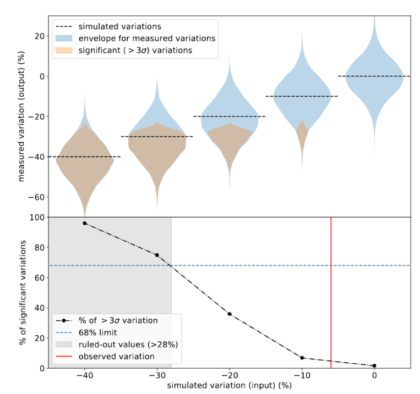
Probing the Galactic Centre Source HESS J1745–290 through long-term monitoring of its gamma-ray flux
June 2026 The latest H.E.S.S. study on the Galactic Centre (GC) takes us back to one of the most fascinating mysteries of very-high-energy astrophysics: what exactly powers the TeV source HESS J1745−290 at the…
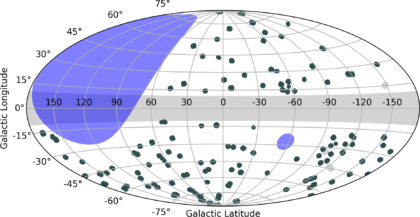
Cataloguing the high-energy Universe: the H.E.S.S. Extragalactic Sky Survey
May 2026 The initial phase of H.E.S.S., during which the array consisted of only the four 12-meter telescopes, lasted from 2004 until 2013, when the fifth telescope was added. Over the course of the…
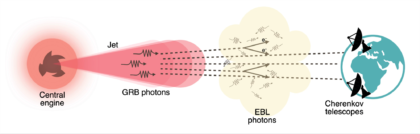
A H.E.S.S. Retrospective on Gamma-Ray Bursts
April 2026 Gamma-ray bursts (GRBs) are the most powerful explosions in the universe, releasing more energy in seconds than our Sun will in its entire lifetime. Since their discovery, understanding the processes that drive…
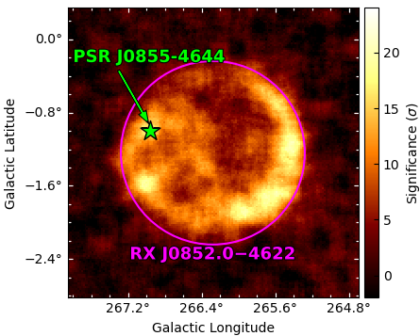
Hidden by the Shell – A Pulsar Wind Nebula Emerges in Vela Junior
March 2026 A pulsar is a highly magnetised, rapidly-rotating neutron star resulting from the collapse of the progenitor star’s compact core during a supernova explosion. This strong magnetic field then induces an electric field…
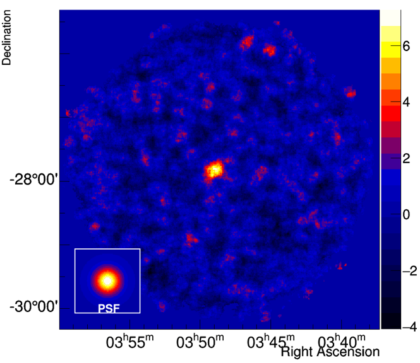
H.E.S.S.’ most distant blazar: PKS 0346−27
February 2026 A galaxy is said to be active if its central supermassive black hole accretes matter from its environment at a high rate, forming an accretion disk. This accretion of matter onto the…
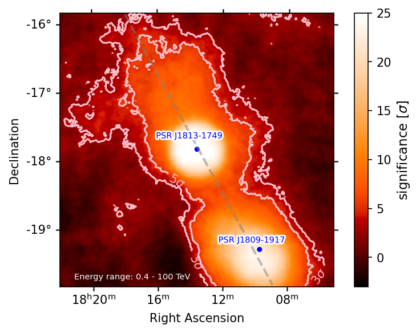
Too Young to Be This Large: The Puzzling Case of HESS J1813–178
January 2026 Earth is constantly bombarded by highly energetic particles from space, known as cosmic rays. Since their discovery, the question of their origin and acceleration mechanism has been one of the central questions…
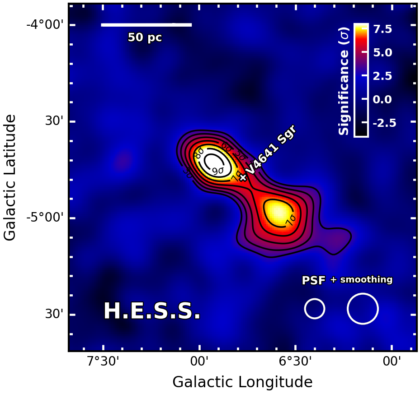
V4641 Sagittarii – the not-so-unremarkable microquasar
December 2025 For decades, we have sought to understand the origin of the most energetic particles in the Universe: cosmic rays. The energy range of cosmic rays arriving to Earth span more than ten…
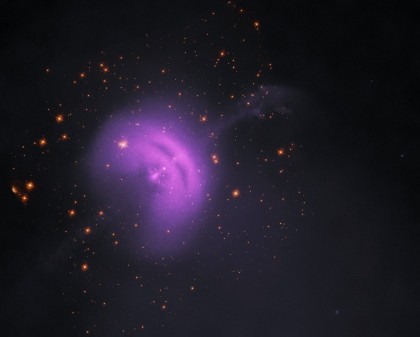
The Vela Pulsar – the most Highly Energetic Clock
November 2023 Pulsars, progeny of supernova explosions, are among the most fascinating beasts in the cosmic zoo. They are rapidly rotating objects exhibiting magnetic field intensities many orders of magnitude larger than what we…
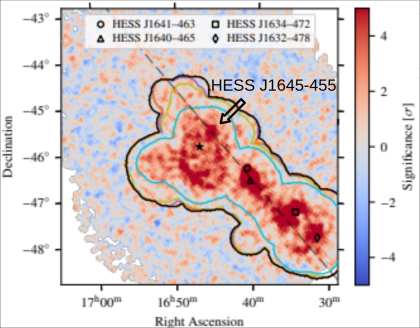
HESS J1645−455 – A gem on the ring?
October 2023 The brightest source of gamma-ray emission in any energy band is the Milky Way. It dominates the all-sky maps obtained with scanning or hemispheric detectors operating in space (e.g. the Fermi-LAT) or…
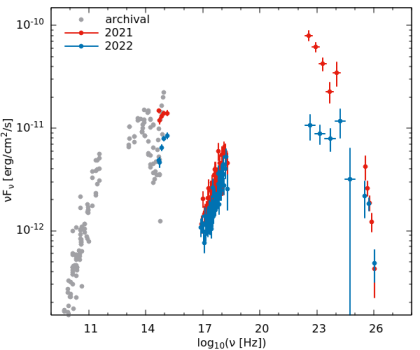
The identity crisis of the blazar PKS 1510-089
August 2023 Blazars are the most abundant sources in the VHE sky and attract a lot of attention by changing their brightness on all time scales that have been probed so far. Variability implies…
