March 2022
Supernovae are exploding stars, and they are among the most spectacular explosions in the Universe. For a few days a supernova may outshine all the stars in a galaxy. But supernovae are also rare; the last one seen in our own Milky Way occurred more than four hundred years ago, in October 1604. We know a few more have occurred since 1604, because we have identified the supernova remnants that they left behind. These supernovae were probably too obscured by interstellar gas to be seen by the naked eye.
Supernova 1604 was first discovered in Italy just hours after the explosion due to a peculiar circumstance: Mars, Jupiter and Saturn were closely aligned and clearly visible as three bright stars in the dawn, this drawing by itself a lot of attention. Then suddenly on October 9 another star appeared that rapidly brightened in a few days. It is now known as SN1604, but is often named Kepler’s supernova, after the famous astronomer Johannes Kepler. He was living in Prague at the time, having been employed by the famous astronomer Tycho Brahe, until the latter passed away in 1601. Prague in October 1604 was plagued by cloudy and rainy weather and Kepler could not immediately observe the new star. However, as soon as he learned of the new star (nova stella in Latin) he started collecting all information he could find, by observing himself as well as gathering information from other astronomers from all over Europe. He collected all of this information in a book, “De Stella Nova” printed in 1606 (Fig. 1, [1]). In the book he speculates on the implications of such bright new stars, which he compared to the star of Bethlehem.

More new stars of this kind were later discovered, and generally named “novae”. Only in the 1930s was it realized that some of these “novae” were much brighter than ordinary novae, among them SN 1064. These exceptional events have since been called supernovae.
Fast forward to 2022: the supernova explosion of SN 1064 has resulted in a blast wave that has swept up the surrounding gas in a hot gas shell (Fig. 2), containing both material surrounding the supernova and material from the explosion itself. For Kepler’s supernova, the material from the explosion contains a lot of iron. This amount of iron is expected from supernovae caused by the explosion of white dwarfs, the compact dense cores of stars. SN1604 is also special because the supernova exploded high above the disc, about 1900 light years, of the Milky Way, where hardly any gas is expected to reside [2]. However, observations show that the shock wave is in fact colliding with dense gas. This dense gas must come from the companion star that was paired with the white dwarf. This is interesting as it could point to the true cause of the white dwarf explosion and therefore the nature of its companion: merging with another white dwarf, or picking up so much mass from a normal star that it could no longer support its own weight.
Supernova remnant shells that are linked to actual supernovae recorded in history are of special importance. Not only are they young, but we also know their exact age, which helps to unravel their explosion properties. As a result, the remnant of SN 1604 is well studied in all forms of light, at radio wavelength, optical light, and X-rays. So we have a good idea about the speed of the shell, its distance, and the gas density in the shell.

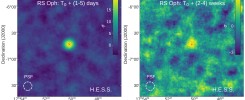
However, until recently, SN1604 had escaped being studied in gamma-ray light. Gamma-ray light is caused by electrons and atomic particles that gain extremely high energies, causing them to move with almost the speed of light. They remain in or near the shell, as the magnetic fields prevent them from wandering too far. Now, H.E.S.S. has found the first evidence that the remnant of Kepler’s supernova is also emitting gamma-ray light (Fig. 3, [3]), which proves that the shocks are speeding up these particles to energies of several teraelectronvolts, which is similar to energies obtained at the Large Hadron Collider at CERN.
By combining the gamma-ray light detected by H.E.S.S. with lower energy gamma-ray light detected by the Fermi satellite, we can also learn what causes the radiation: energetic electrons or energetic atomic particles. The latter radiate as they are colliding with dense gas. The collisions make lots of new particles, called pions, and these fall apart thereby creating gamma-ray light as also reported in [4]. From the brightness comparison at low and higher gamma-ray energies, we can now conclude that the emission is likely dominated by atomic particles rather than electrons. This is consistent with the fact that the remnant of Kepler’s supernova is expanding through the dense gas shell created by the white dwarf companion star.
In many ways, the gamma-ray radiation from the remnant of Kepler’s supernova is very similar to that of another famous supernova remnant, that of SN1572, which was also caused by an exploding white dwarf. Interestingly, that remnant is named after Kepler’s former employer, Tycho Brahe. Tycho Brahe and Johannes Kepler are thus once more associated, but now in the catalog of gamma-ray emitting supernova remnants.

References
[1] Kepler, J., De Stella nova in pede serpentarii, et qui sub ejus exortum de novo iniit, Trigono igneo, Prague 1606
[2] Vink, J., 2017, Supernova 1604, Kepler’s Supernova, and its Remnant, Handbook of Supernovae, ISBN 978-3-319-21845-8. Springer International Publishing AG, p. 139
[3] H.E.S.S. Collaboration, Aharonian, F., et al., 2022, Evidence for gamma-ray emission from the remnant of Kepler’s supernova based on deep H.E.S.S. observations, A&A submitted, arXiv:2201.05839
[4] Acero, F., Lemoine-Goumard, M., Ballet, J., Characterization of the GeV emission from the Kepler supernova remnant, A&A in press, arXiv:2201.05567