H.E.S.S. CollaborationH.E.S.S. Collaboration
  • About H.E.S.S.
    • H.E.S.S. Collaboration
      • Organisation
    • H.E.S.S. Science
    • H.E.S.S. Telescopes
    • H.E.S.S. Prize
  • News
    • Announcements
    • Press releases
    • Archival news
  • Source of the month
  • For scientists
    • Publications
      • Journals
      • Conferences
      • Astronomers Telegram
    • External Proposals
      • Visibility calculator
    • GRB observation schedule
    • Public test data release
    • Telescope specifications
  • Contact
March 1, 2006 by H.E.S.S. Collaboration
Source of the Month

High Energy Gamma Rays from the Galactic Center Ridge

High Energy Gamma Rays from the Galactic Center Ridge
March 1, 2006 by H.E.S.S. Collaboration
Source of the Month

March 2006

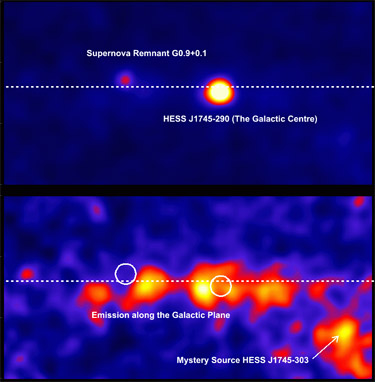
Top: TeV gamma rays from the Galactic Center region show two prominent point sources, one located right at the Galactic Center (see also December 2004) and one about a degree away, coincident with the supernova remnant G0.9+01 (see also February 2005). Bottom: after subtraction of the emission from the two point sources and an adjustment of the color scale, a band of gamma ray emission emerges, tracing the Galactic Plane. Below the Plane, the additional source HESS J1745-303 is visible.


Very high energy gamma rays can be used to probe the flux of cosmic rays in distant regions of the Galaxy, shedding light on the question if the flux and spectrum of cosmic rays is uniform throughout the Galaxy, and identical to the flux measured on Earth. When cosmic rays propagate through the interstellar gas, they sometimes interact with gas particles, creating gamma rays (Fig. 1). The flux of gamma rays is proportional to the flux of “beam particles” – the cosmic rays – times the density of “target particles” – the interstellar gas. Therefore, one expects to see an enhanced gamma ray flux from the direction of dense molecular clouds, and if the cloud masses and their distances are known, one can determine to flux of cosmic rays in the gas clouds (see e.g.Aharonian 2001). Also, the energy spectrum of gamma rays resembles the energy spectrum of the cosmic rays. In the GeV energy range, this technique was used by the EGRET instrument, which revealed the band of the Galaxy glowing in gamma rays (Hunter et al., 1997), but the angular resolution of EGRET was not sufficient to resolve individual clouds.

With its good resolution and sensitivity, H.E.S.S. is in an excellent position to search for gamma rays from molecular clouds, and a first target were the very massive and dense clouds near the Galactic Center, encompassing a total gas mass of several 10 million solar masses. The clouds are mapped via their radio emission in the CO and CS lines (Oka et al. 1998,Tsuboi et al. 1999); the more common hydrogen lines are less suitable since the clouds are so dense that they are optically thick, i.e. part of the emission is absorbed in the cloud, resulting in an underestimate of the cloud mass. Indeed, once the emission from two prominent point sources in the Galactic Center region is subtracted (see Figure above), an extended band of “diffuse” gamma ray emission is visible tracing the Galactic Plane. Both in its distribution in Galactic Longitude (Fig. 2) and in Galactic Latitude, the gamma ray flux is essentially proportional to the gas density. Only at Galactic Longitude > 1 degr. on finds a deficit. A plausible explanation is that the Galactic Center clouds are illuminated by a cosmic-ray accelerator which turned on some 10000 years before the gamma rays were emitted; during these 10000 years, the cosmic rays – which meander in interstellar magnetic fields – can only propagate over some 100 pc; they have not yet reached the gas clouds at larger distance from the accelerator. This interpretation assuming a local cosmic-ray accelerator at the center of the Galaxy is supported by the measured gamma ray spectrum, which is more intense and which contains more high-energy gamma rays than expected based on the flux and spectrum of cosmic rays near Earth (Fig. 3). Near an accelerator, one naturally expects a higher intensity and harder spectrum of radiation. A candidate source might begiant supernova (Maeda et al. 2002) which might have occurred very near the Galactic Center in pre-historic time.

References:

Discovery of very-high-energy gamma rays from the Galactic Centre ridge, F. Aharonian et al., Nature 439 (2006) 695, see alsoH.E.S.S. press release
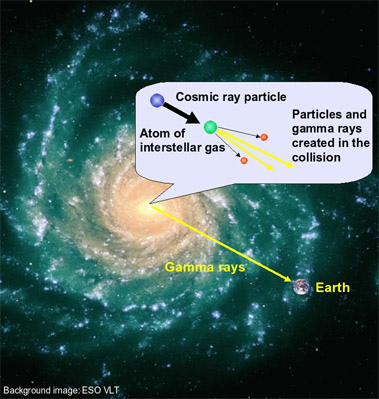
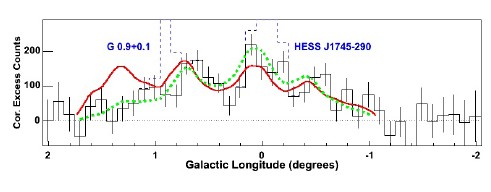
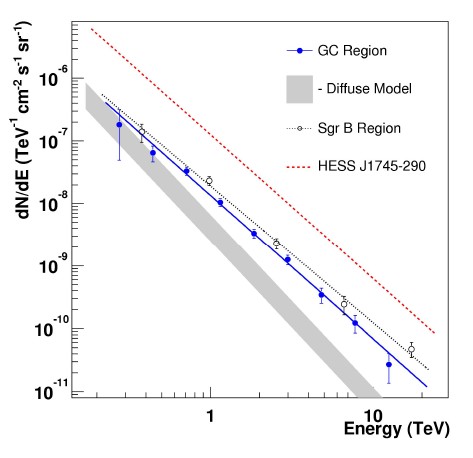
Fig. 1: “Diffuse” sources of gamma rays are created when high-energy cosmic rays permeate the interstellar medium and interact with interstellar gas particles. The flux of gamma rays can be used to probe the local cosmic-ray flux, and their spectrum reflects the cosmic-ray spectrum.

Fig. 2: Distribution of gamma-ray flux in Galactic Longitude (black histogram), compared to the density of interstellar gas (red curve). The dashed green lines represent the expected flux – given by the product of gas density and cosmic-ray flux – assuming that the cosmic-ray source was active since about 10000 years, in which case the maximum propagation distance of cosmic rays is about 1 degr. in Longitude.

Fig. 3: Energy spectrum of gamma rays from the Galactic Center ridge (blue points) and from the Sgr B subregion (open circles), compared to the expected spectrum assuming that the cosmic ray flux near the Galactic Center is identical to the flux near Earth (shaded band).

Previous articlePG 1553+113 - the mystery AGNNext article The Wings of the Kookaburra

Sources of the month

Each month a TeV gamma ray source investigated with the H.E.S.S. telescopes is featured. See also the pages on Astrophysics with H.E.S.S.: The Nonthermal Universe with an overview of the physics and the source types.

Latest sources

The Vela Pulsar – the most Highly Energetic ClockNovember 1, 2023
HESS J1645−455 – A gem on the ring?October 1, 2023
The identity crisis of the blazar PKS 1510-089August 1, 2023

Tags

Atmosphere (1) black holes (2) Blazar (1) Cosmic rays (1) Extragalactic (2) Galactic Center (1) galactic plane (3) galactic source (1) Gamma-ray binary (2) gamma-rays (3) neutrinos (1) Nova (1) pulsar (1)

Contact

You can contact us for scientific queries and general information using:
contact.hess@hess-experiment.eu

Data Privacy Statement

https://www.mpi-hd.mpg.de/mpi/de/datenschutzhinweis
H.E.S.S. collaboration official website. Proudly Built By H.E.S.S. members.
(c) 2004-2025 by the H.E.S.S. collaboration

Last sources of the month

The Vela Pulsar – the most Highly Energetic ClockNovember 1, 2023
HESS J1645−455 – A gem on the ring?October 1, 2023
The identity crisis of the blazar PKS 1510-089August 1, 2023

Internal

  • Log in
  • Entries feed
  • Comments feed
  • WordPress.org
H.E.S.S. Collaboration
Manage Consent
To provide the best experiences, we use technologies like cookies to store and/or access device information. Consenting to these technologies will allow us to process data such as browsing behavior or unique IDs on this site. Not consenting or withdrawing consent, may adversely affect certain features and functions.
Functional Always active
The technical storage or access is strictly necessary for the legitimate purpose of enabling the use of a specific service explicitly requested by the subscriber or user, or for the sole purpose of carrying out the transmission of a communication over an electronic communications network.
Preferences
The technical storage or access is necessary for the legitimate purpose of storing preferences that are not requested by the subscriber or user.
Statistics
The technical storage or access that is used exclusively for statistical purposes. The technical storage or access that is used exclusively for anonymous statistical purposes. Without a subpoena, voluntary compliance on the part of your Internet Service Provider, or additional records from a third party, information stored or retrieved for this purpose alone cannot usually be used to identify you.
Marketing
The technical storage or access is required to create user profiles to send advertising, or to track the user on a website or across several websites for similar marketing purposes.
Manage options Manage services Manage {vendor_count} vendors Read more about these purposes
View preferences
{title} {title} {title}