The results of gamma-ray observations of the binary system HESS J0632+057 collected during 450 hr over 15 yr, between 2004 and 2019, are presented. Data taken with the atmospheric Cherenkov telescopes H.E.S.S., MAGIC, and VERITAS at energies above 350 GeV were used together with observations at X-ray energies obtained with Swift-XRT, Chandra, XMM-Newton, NuSTAR, and Suzaku. Some of these observations were accompanied by measurements of the Hα emission line. A significant detection of the modulation of the very high-energy gamma-ray fluxes with a period of 316.7 ± 4.4 days is reported, consistent with the period of 317.3 ± 0.7 days obtained with a refined analysis of X-ray data. The analysis of data from four orbital cycles with dense observational coverage reveals short-timescale variability, with flux-decay timescales of less than 20 days at very high energies. Flux variations observed over a timescale of several years indicate orbit-to-orbit variability. The analysis confirms the previously reported correlation of X-ray and gamma-ray emission from the system at very high significance, but cannot find any correlation of optical Hα parameters with fluxes at X-ray or gamma-ray energies in simultaneous observations. The key finding is that the emission of HESS J0632 + 057 in the X-ray and gamma-ray energy bands is highly variable on different timescales. The ratio of gamma-ray to X-ray flux shows the equality or even dominance of the gamma-ray energy range. This wealth of new data is interpreted taking into account the insufficient knowledge of the ephemeris of the system, and discussed in the context of results reported on other gamma-ray binary systems.

Corresponding authors: Gernot Maier, Daniela Hadasch, Alicia Lopez-Oramas, Denys Malyshev, Gerd Puelhofer.
Link to the data on Zenodo
Main paper
Figure 2 and Figure 3
Data points – H.E.S.S. light curve
Data points – MAGIC light curve
Data points – VERITAS light curve
Data points – X-rays light curve

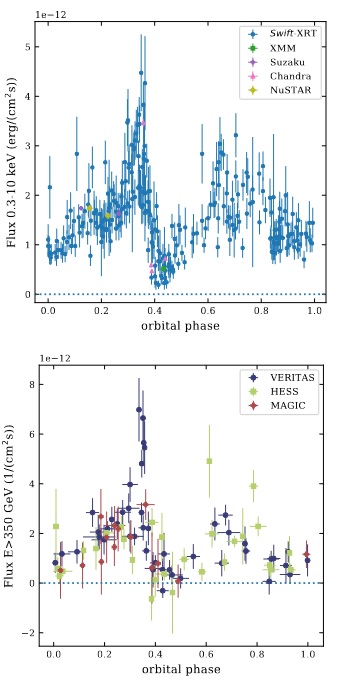
Figure 4
Data points – optical light curve

Figure 5
Data points – TeV vs keV fluxes
Data points – correlation coefficient
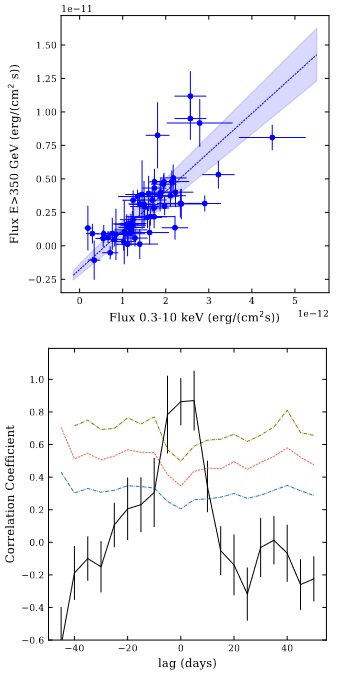
Figure 6
Data points – TeV vs Halpha
Data points – keV vs Halpha
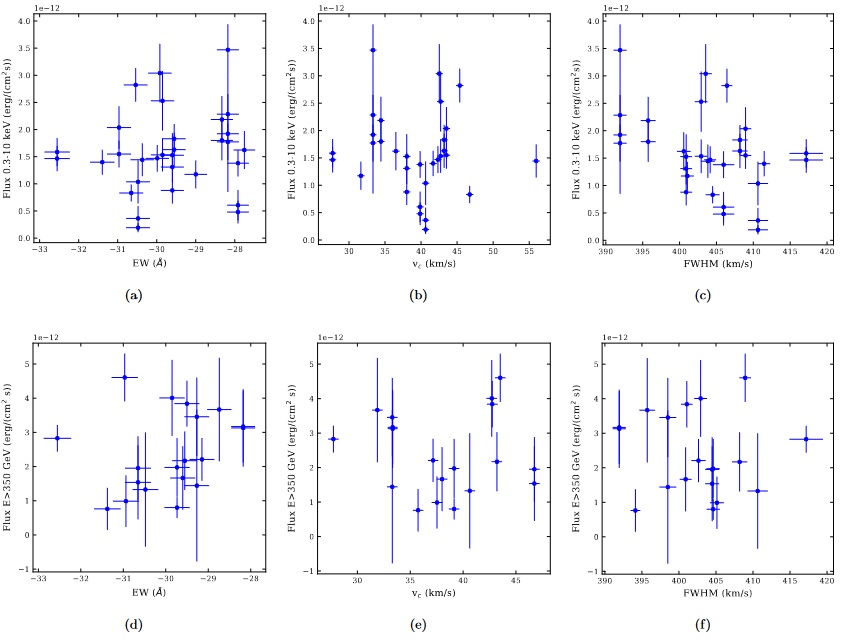
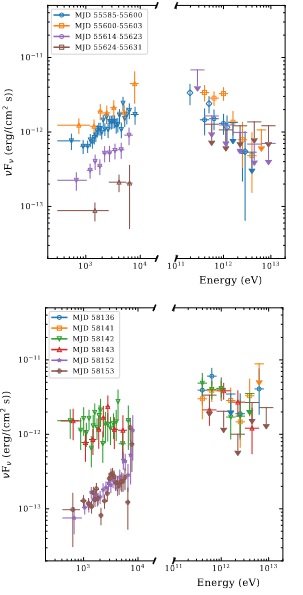
Figure 7 and Figure 8
Data points – HESS (orbital phases 0.2-0.4)
Data points – MAGIC (orbital phases 0.2-0.4)
Data points – VERITAS (orbital phases 0.2-0.4)
Data points – Swift/XRT (orbital phases 0.2-0.4)
Data points – HESS (orbital phases 0.4-0.6)
Data points – MAGIC (orbital phases 0.4-0.6)
Data points – VERITAS (orbital phases 0.4-0.6)
Data points – Swift/XRT (orbital phases 0.4-0.6)
Data points – HESS (orbital phases 0.6-0.8)
Data points – VERITAS (orbital phases 0.6-0.8)
Data points – Swift/XRT (orbital phases 0.6-0.8)
Data points – HESS (orbital phases 0.8-0.2)
Data points – MAGIC (orbital phases 0.8-0.2)
Data points – VERITAS (orbital phases 0.8-0.2)
Data points – Swift/XRT (orbital phases 0.8-0.2)

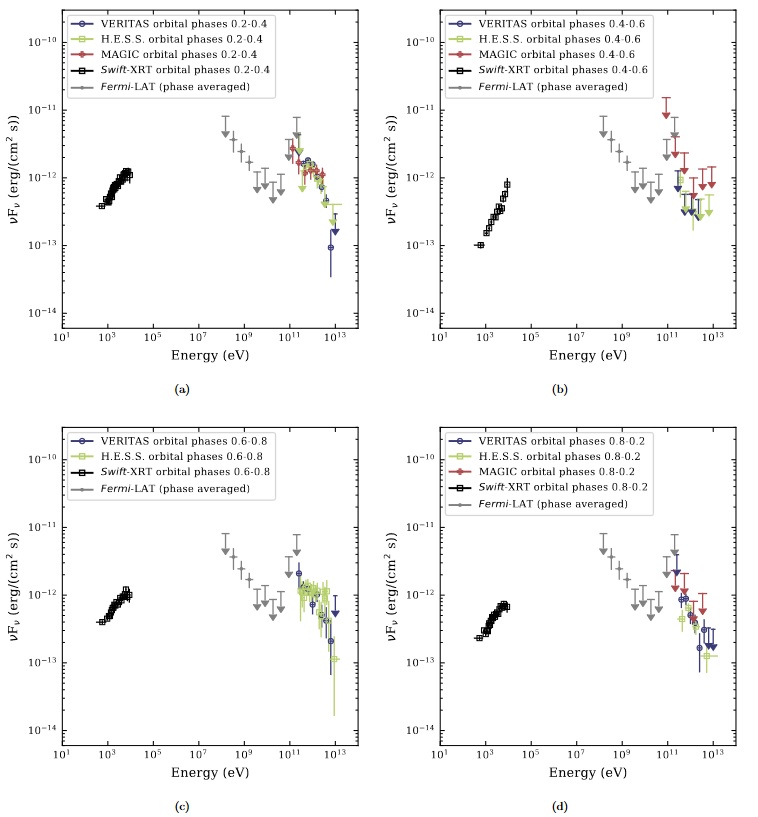
Figure 9
Data points – H.E.S.S. light curve
Data points – MAGIC light curve
Data points – VERITAS light curve
Data points – X-rays light curve
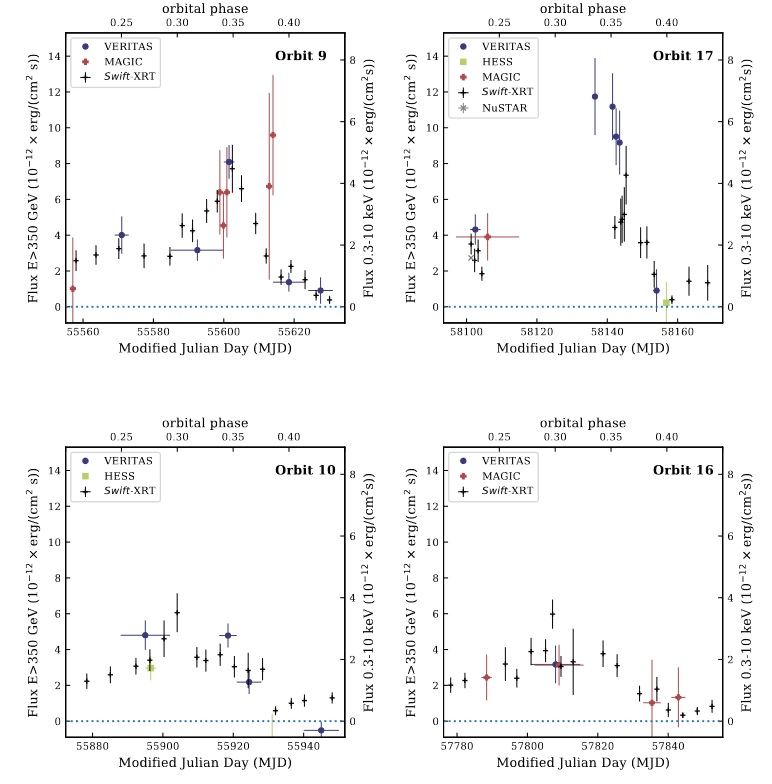
Figure 10
Collaboration Acknowledgement
The support of the Namibian authorities and of the University of Namibia in facilitating the construction and operation of H.E.S.S. is gratefully acknowledged, as is the support by the German Ministry for Education and Research (BMBF), the Max Planck Society, the German Research Foundation (DFG), the Helmholtz Association, the Alexander von Humboldt Foundation, the French Ministry of Higher Education, Research and Innovation, the Centre National de la Recherche Scientifique (CNRS/IN2P3 and CNRS/INSU), the Commissariat à l’Énergie atomique et aux Énergies alternatives (CEA), the U.K. Science and Technology Facilities Council (STFC), the Knut and Alice Wallenberg Foundation, the National Science Centre, Poland grant no. 2016/22/M/ST9/00382, the South African Department of Science and Technology and National Research Foundation, the University of Namibia, the National Commission on Research, Science & Technology of Namibia (NCRST), the Austrian Federal Ministry of Education, Science and Research and the Austrian Science Fund (FWF), the Australian Research Council (ARC), the Japan Society for the Promotion of Science and by the University of Amsterdam. We appreciate the excellent work of the technical support staff in Berlin, Zeuthen, Heidelberg, Palaiseau, Paris, Saclay, Tübingen and in Namibia in the construction and operation of the equipment. This work benefited from services provided by the H.E.S.S. Virtual Organisation, supported by the national resource providers of the EGI Federation.
