
H.E.S.S. CollaborationH.E.S.S. Collaboration
  • About H.E.S.S.
    • H.E.S.S. Collaboration
      • Organisation
    • H.E.S.S. Science
    • H.E.S.S. Telescopes
    • H.E.S.S. Prize
  • News
    • Announcements
    • Press releases
    • Archival news
  • Source of the month
  • For scientists
    • Publications
      • Journals
      • Conferences
      • Astronomers Telegram
    • External Proposals
      • Visibility calculator
    • GRB observation schedule
    • Public test data release
    • Telescope specifications
  • Contact
May 1, 2005 by H.E.S.S. Collaboration
Source of the Month

HESS J1303-631 – the mystery TeV source

HESS J1303-631 – the mystery TeV source
May 1, 2005 by H.E.S.S. Collaboration
Source of the Month

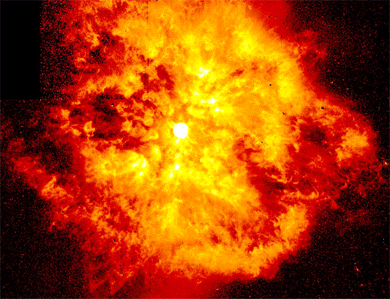
Is this what is behind the TeV source HESS J1303-631? Some stars, like the Wolf-Rayet star WR124, have enormous stellar winds resulting in shock waves akin to those produced in supernova explosions, and potentially capable of accelerating particles to high energies. (Y. Grosdidier (U. Montreal) et al.)


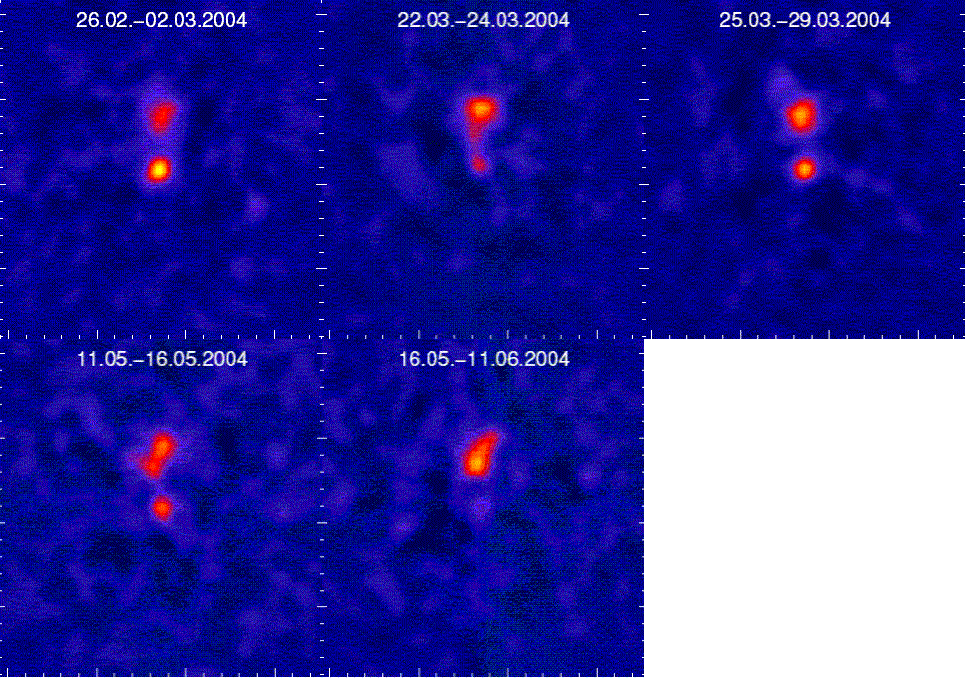
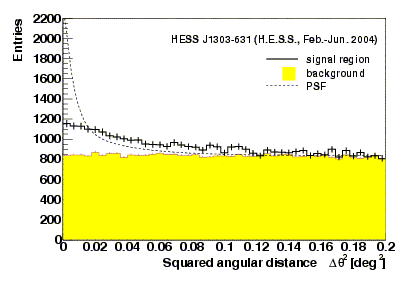
Observations of the binary pulsar PSR B1259-63 reveal, apart from a clear TeV gamma ray signal from the pulsar,  a big surprise: a second source of TeV gamma rays about 0.5o north of the pulsar (Fig. 1).  In distinction to the time-variable signal from the pulsar, this second source appears steady. The image of the source is significantly wider than the well-understood point-spread function of the H.E.S.S. instrument, indicating an extended source (Fig. 2). Assuming a Gaussian source profile, the (rms) source width is estimated to 0.16o. Both the source extension and its location – within 0.5o from the Galactic plane – argue for an object in our Galaxy. However, there is no obvious counterpart in other wavelength regimes, with which the source could be identified. Many such unidentified sources appear at lower energies in the EGRET source catalogue (Hartman et al. 1999), but there the reason is partly given by the poor angular resolution of EGRET, which makes it difficult to uniquely identify a counterpart. At TeV energies, only one such source without obvious conterpart is known, detected by HEGRA (Aharonian et al. 2002). All other TeV sources found so far can be associated with well-known objects such as active galactic nuclei or supernova remnants. The new source, named HESS J1303-631, exhibits a power-law energy spectrum, measured between 0.5 TeV and 10 TeV, with a photon spectral index of 2.4 and a flux of roughly 17% of the flux from the Crab Nebula. The exact source coordinates are 13h3m3.4s+-4.4s, -63o11’55″+-31″.
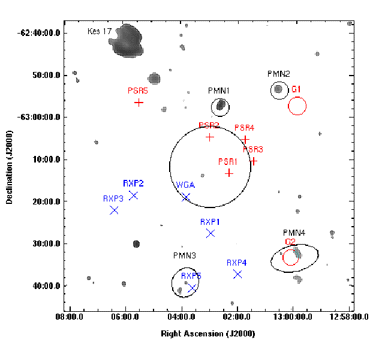
Various possible explanations for the origin of the gamma rays have been discussed. The lack of strong X-ray or radio signals from the region, i.e. the absence of prominent synchrotron radiation, suggest that this may be a proton accelerator, as opposed to the high-energy electrons which are dominant in many TeV sources and which provide a clear synchrotron radiation signature. Protons could e.g. be accelerated in the winds of OB stars (Montmerle 1979). Such stars have high-velocity outflows which could generate termination shocks when the wind pressure is balanced by the ambient medium, and in these shocks accelerate particles. HESS J1303-631 is indeed close to an association of OB stars, Cen OB 1 (Hartkopf et. al. 1999).  The gamma rays could also be generated in pulsar wind nebulae, similar to the Crab Nebula or PSR1259-63. Several pulsars are know with positions close to HESS J1303-631 (Fig. 3). From the energetics point of view, however, none of the pulsars is a plausible counterpart, since the gamma-ray luminosity alone equals or exceeds their spin-down energy loss. One could also imagine a dense gas cloud illuminated by cosmic rays as the origin of the gamma-ray signal. A search in CO catalogs (Bronfman et al. 1989) yields enhanced densities of interstellar gas a various distances  from Earth, but only a combination of such clouds with a local cosmic-ray source could generate the observed source profile and flux. Another potential explanation is radiation generated in the annihilation of dark matter accumulated in the halo of our Galaxy. In the hierarchical process of structure formation, dark matter clumps were generated, many of which may have survived until today (Moore et al. 1999). However, it seems unlikely that such a dark matter clump will generate such intense gamma-ray signals, and the angular distribution should be more strongly peaked. More sensitive follow-up measurements in the X-ray and radio regimes might help to pin down the physics of this new source.
References:

Serendipitous discovery of the unidentified extended TeV gamma-ray source HESS J1303-631, H.E.S.S. collaboration, F. Aharonian et al., A&A, in press
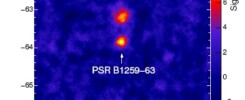
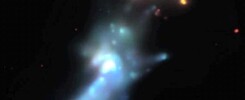
Fig. 1: About 0.5 degrees north (uward) of the pulsar B1259-63 (which is at the center of the image), a second source appears in the field of view of the H.E.S.S. telescopes. Whereas the gamma ray flux from the pulsar varies significantly over months, the new source appears steady, within statistics.

Fig. 2: Angular distribution of the detected gamma-ray candidates, relative to the center of the source. The yellow area is an estimate for the background, which should be constant in the squared angular distance, as plotted here. The full line shows the signal from the source, the dashed line the angular distribution expected for a point source of gamma rays.

Fig. 3: Radio and X-ray sources near the location of HESS J1303-631 (the big circle indicates the source region). Of the pulsars (PSR) in or near the source region, none seems energetic enough to power the TeV gamma-ray source.

Previous articleTeV gamma rays from the Binary Pulsar PSR B1259-63Next article MSH 15-5 2 - a Pulsar Wind Nebula with a Jet

Sources of the month

Each month a TeV gamma ray source investigated with the H.E.S.S. telescopes is featured. See also the pages on Astrophysics with H.E.S.S.: The Nonthermal Universe with an overview of the physics and the source types.

Latest sources

The Vela Pulsar – the most Highly Energetic ClockNovember 1, 2023
HESS J1645−455 – A gem on the ring?October 1, 2023
The identity crisis of the blazar PKS 1510-089August 1, 2023

Tags

Atmosphere (1) black holes (2) Blazar (1) Cosmic rays (1) Extragalactic (2) Galactic Center (1) galactic plane (3) galactic source (1) Gamma-ray binary (2) gamma-rays (3) neutrinos (1) Nova (1) pulsar (1)

Contact

You can contact us for scientific queries and general information using:
contact.hess@hess-experiment.eu

Data Privacy Statement

https://www.mpi-hd.mpg.de/mpi/de/datenschutzhinweis
H.E.S.S. collaboration official website. Proudly Built By H.E.S.S. members.
(c) 2004-2025 by the H.E.S.S. collaboration

Last sources of the month

The Vela Pulsar – the most Highly Energetic ClockNovember 1, 2023
HESS J1645−455 – A gem on the ring?October 1, 2023
The identity crisis of the blazar PKS 1510-089August 1, 2023

Internal

  • Log in
  • Entries feed
  • Comments feed
  • WordPress.org
H.E.S.S. Collaboration
Manage Consent
To provide the best experiences, we use technologies like cookies to store and/or access device information. Consenting to these technologies will allow us to process data such as browsing behavior or unique IDs on this site. Not consenting or withdrawing consent, may adversely affect certain features and functions.
Functional Always active
The technical storage or access is strictly necessary for the legitimate purpose of enabling the use of a specific service explicitly requested by the subscriber or user, or for the sole purpose of carrying out the transmission of a communication over an electronic communications network.
Preferences
The technical storage or access is necessary for the legitimate purpose of storing preferences that are not requested by the subscriber or user.
Statistics
The technical storage or access that is used exclusively for statistical purposes. The technical storage or access that is used exclusively for anonymous statistical purposes. Without a subpoena, voluntary compliance on the part of your Internet Service Provider, or additional records from a third party, information stored or retrieved for this purpose alone cannot usually be used to identify you.
Marketing
The technical storage or access is required to create user profiles to send advertising, or to track the user on a website or across several websites for similar marketing purposes.
Manage options Manage services Manage {vendor_count} vendors Read more about these purposes
View preferences
{title} {title} {title}