September 2006
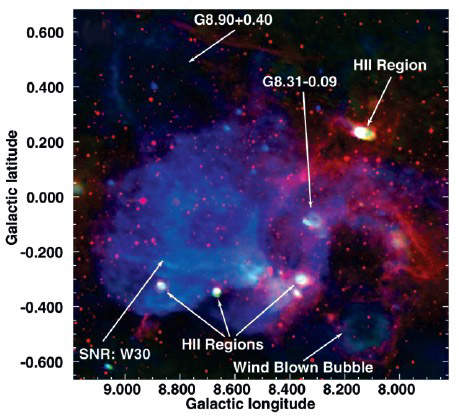
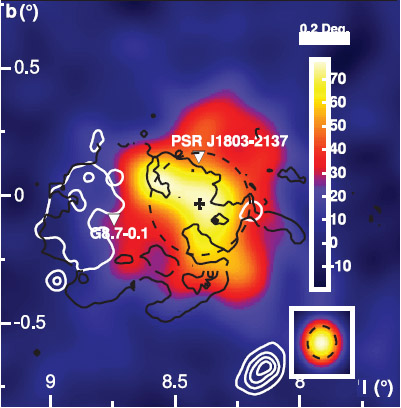
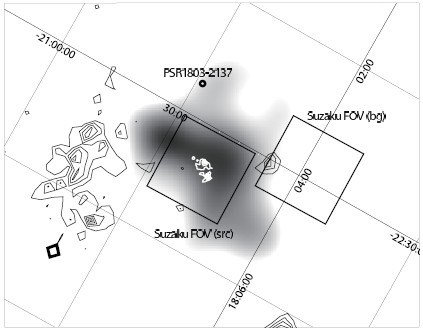
HESS J1804-216 (Fig. 1), at Galactic longitude 8.4 degr. and latitude -0.03 degr. is an extended source of gamma rays, with a Gaussian width of about 0.2 degr. With a flux of about 25% of the Crab Nebula, it is among the brightest H.E.S.S. gamma-ray sources. HESS J1804-216 is spatially concident with the W30 complex, which contains theG8.7-0.1 supernova remnant, a very complex and interesting region (top figure). At meter radio wavelengths, W30 appears as an almost 1 degr. wide region of extended emission, composed of a number of of superimposed sources (e.g.Reich et al. 1994); among these, a nonthermal contribution – presumably synchrotron radiation from high-energy electrons – was detected and used to identify a supernova remnant, G8.7-0.1 (Odegard 1986). Based on new VLA observations at 90 cm and 20 cm combined with archival radio data,Kassim and Weiler (1990a) achieved an improved separation of thermal and nonthermal emission. From the known distance of foreground and background H II regions, they derived a distance to G8.7-0.1 of 61 kpc, implying a linear size of the remnant of about 80 pc, among the largest known Galactic supernova remnants.Kassim and Weiler (1990b) also speculated that the pulsar PSR 1800-21 (or PSR J1803-2137) at the western edge of the remnant may have been created in the explosion responsible for the remnant, supported by the observation that the distance to the pulsar – about 5 kpc – is consistent with the distance of the remnant. A caveat is that the angular distance between pulsar and center of the remnant, combined with a pulsar characteristic age of about 16000 years, would require a pulsar velocity of 1700 km/s, much larger than typical pulsar speeds resulting from asymmetries in the supernova explosion. Whether this association is real has been subject of some discussion.Frail et al. (1994) argue that a such high speeds one would expect to see a cometary pulsar wind nebula, confined and shaped by the ram pressure of the interstellar medium, as seen for other high-velocity pulsars (e.g. PSR J1747-2958,Gaensler et al. 2004). Also based on a revised pulsar distance of 3.9 kpc, they conclude that PSR 1800-21 may be a foreground pulsar not related to G8.7-0.1. However, also in 1994, ROSAT detected X-rays both from the northern part of the shell, and from the pulsar (Finley and Ögelman, 1994), see Fig. 1, Fig. 2. On the basis of the remnant parameters and -energetics, they favor a distance around 4 kpc, again consistent with the pulsar distance, and argue that the explosion may have taken place near the current position of the pulsar, explaining the then asymmetric morphology of the remnant with interactions with a complex of molecular clouds. More recently,Brogan et al. (2006) published the discovery in radio of another supernova remnant in the W30 region, G8.31-0.09, located within the H.E.S.S. source, but more compact in size (see top figure). Using SWIFT dataLandi et al. (2006) found three faint X-ray sources in the region of HESS J1804-216, one of them near the center of the gamma-ray source, and Bamba et al. (2006) reported the discovery of two X-ray sources with Suzaku, centered on the H.E.S.S. source, but again much smaller in size (Fig. 2).
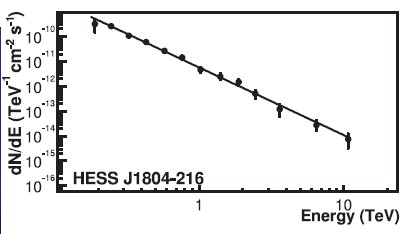
The H.E.S.S. source J1804-216 is centered about 0.2 degr. away from the pulsar (Fig. 1, Fig. 2), and displaced by about the same amount from the center of the roughly circular emission region seen in the radio data. Given the extended morphology of the H.E.S.S. source, it seems plausible to attribute gamma-ray emission either to electrons or nucleons accelerated in the supernova shocks, or to electrons in a pulsar wind nebula; the pulsar has a high spin-down luminosity and could easily power the source. The distance between gamma-ray emission region and pulsar seemed large compared to classical views of pulsar wind nebulae, but similar distances are now observed in a number of other, highly plausible pulsar wind associations. The gamma-ray spectral index – with 2.7 the spectrum (Fig. 3) is relatively steep – could be accommodated in both scenarios, although one typically would expect to see some steepening of the spectrum across the H.E.S.S. energy range, which is not detected with current statistics. Unfortunately, the sensitive Suzaku exposures do not cover the pulsar, where the detection of an X-ray pulsar wind nebula would strengthen an identification.
For the two X-ray sources near the center of the H.E.S.S. source, the ratio of X-ray flux to gamma-ray flux is much lower than for “typical” Inverse-Compton gamma-ray sources; the same holds for the diffuse emission integrated over the full Suzaku field of view as shown in Fig. 2 (Bamba et al. 2006). The latter result questions the interpretation of HESS J1804-216 as a pulsar wind nebula. Unless one assumes unusually small magnetic fields, and correspondingly reduced synchrotron radiation, it seems unlikely that accelerated electrons in this region are responsible for the gamma rays. Large ratios of gamma-ray energy flux to X-ray flux could, however, occur in old supernova remnants, where the electrons have already lost most of the energy, and only nucleonic cosmic rays are left over (Yamazaki et al. 2006).
References:
The H.E.S.S. survey of the Inner Galaxy in very high-energy gamma-rays, H.E.S.S. collaboration, F. Aharonian et al.,Astrophysical Journal 636 (2006) 777-797