H.E.S.S. CollaborationH.E.S.S. Collaboration
  • About H.E.S.S.
    • H.E.S.S. Collaboration
      • Organisation
    • H.E.S.S. Science
    • H.E.S.S. Telescopes
    • H.E.S.S. Prize
  • News
    • Announcements
    • Press releases
    • Archival news
  • Source of the month
  • For scientists
    • Publications
      • Journals
      • Conferences
      • Astronomers Telegram
    • External Proposals
      • Visibility calculator
    • GRB observation schedule
    • Public test data release
    • Telescope specifications
  • Contact
March 1, 2021 by H.E.S.S. Collaboration
Source of the Month

30 Doradus C -The high-energy superbubble

30 Doradus C -The high-energy superbubble
March 1, 2021 by H.E.S.S. Collaboration
Source of the Month

March 2021

If you ever find yourself star-gazing in a very dark place in the southern Hemisphere (like at the H.E.S.S. telescope site in Namibia!), try to look for the Large Magellanic Cloud; it will look like a faint haze (a cloud, if you will) not too far above the horizon. The Large Magellanic Cloud is a low-mass companion galaxy of the Milky Way, and is home to a spectacular region of vigorous star formation. 30 Doradus — or 30 Dor — is the largest and brightest star forming region within tens of millions of light-years from Earth, and contains many young massive stars formed in giant molecular clouds. These massive stars lose significant mass at extremely fast rates to stellar winds; when clusters of stars undergo this phase at the same time, their winds combine and drive a Superbubble into the surrounding giant molecular clouds from which the young stars were formed. At the outskirts of 30 Dor lies an association of several clusters, catalogued as LH90, which has blown one of the largest superbubbles in the Magellanic Clouds: 30 Dor C ([1], [2]).
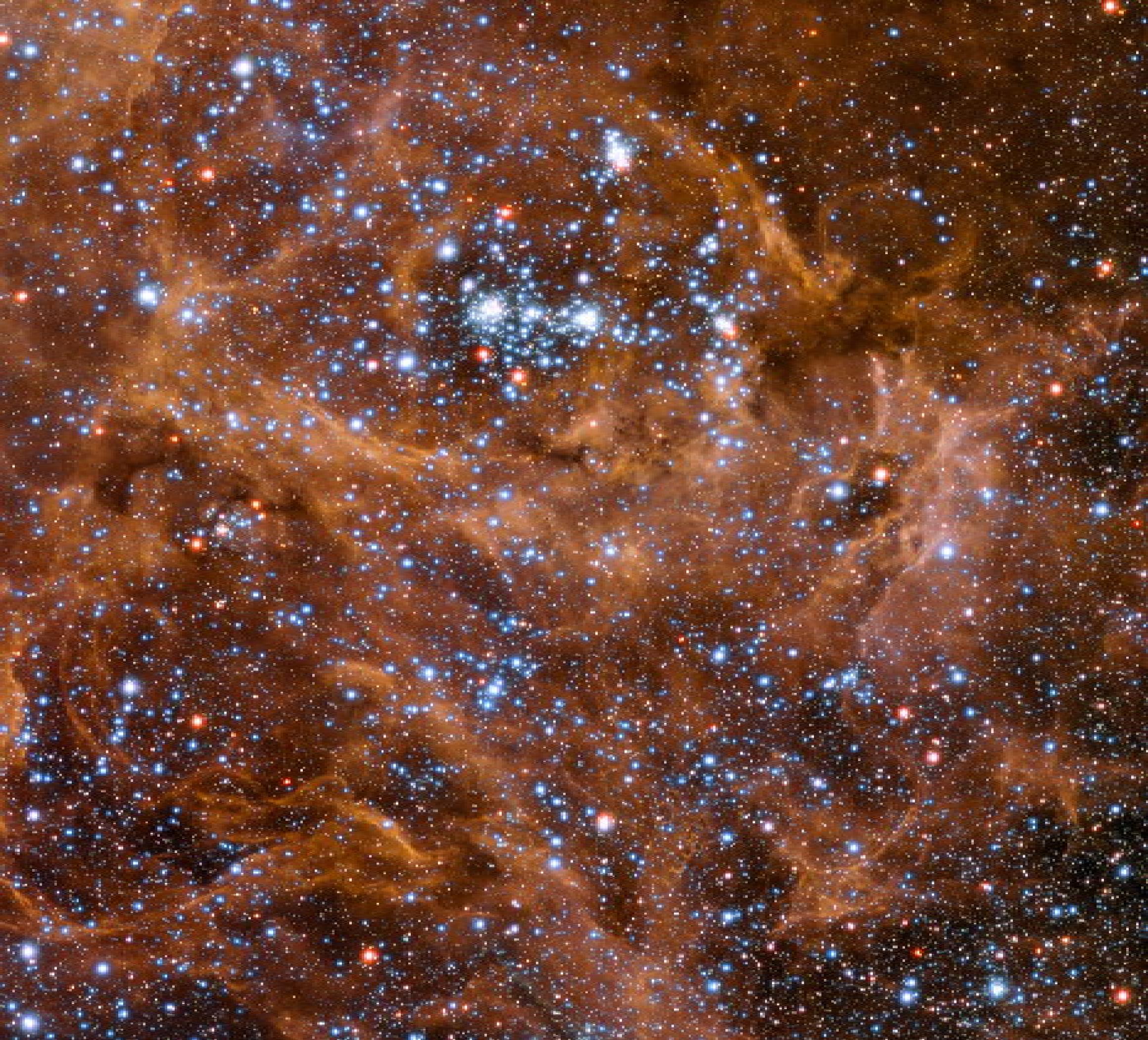
fig1
Fig. 1: This optical image of 30 Dor C shows the shell structure glowing in H alpha emission surrounding the young clusters of the LH90 association. Credit: ESO.

30 Dor C is an extremely intriguing object, being the largest X-ray source with predominantly non-thermal emission in the Milky Way system. It is one of only two known superbubbles in the Local Group that emit hard non-thermal X-ray emission. In general, the X-ray emission of the interior of superbubbles is caused by low-density thermal plasma. The X-ray spectrum of 30 Dor C, however, indicates that non-thermal synchrotron radiation dominates in this object. This discovery, in turn, confirms the existence of a dominant population of ultra-relativistic electrons, which have gained energy in strong shocks that must have occurred recently inside the superbubble. The presence of large quantities of freshly accelerated electrons in 30 Dor C was a strong indication that this superbubble might also be detectable in Very High Energy (VHE) gamma rays with the H.E.S.S. telescopes.
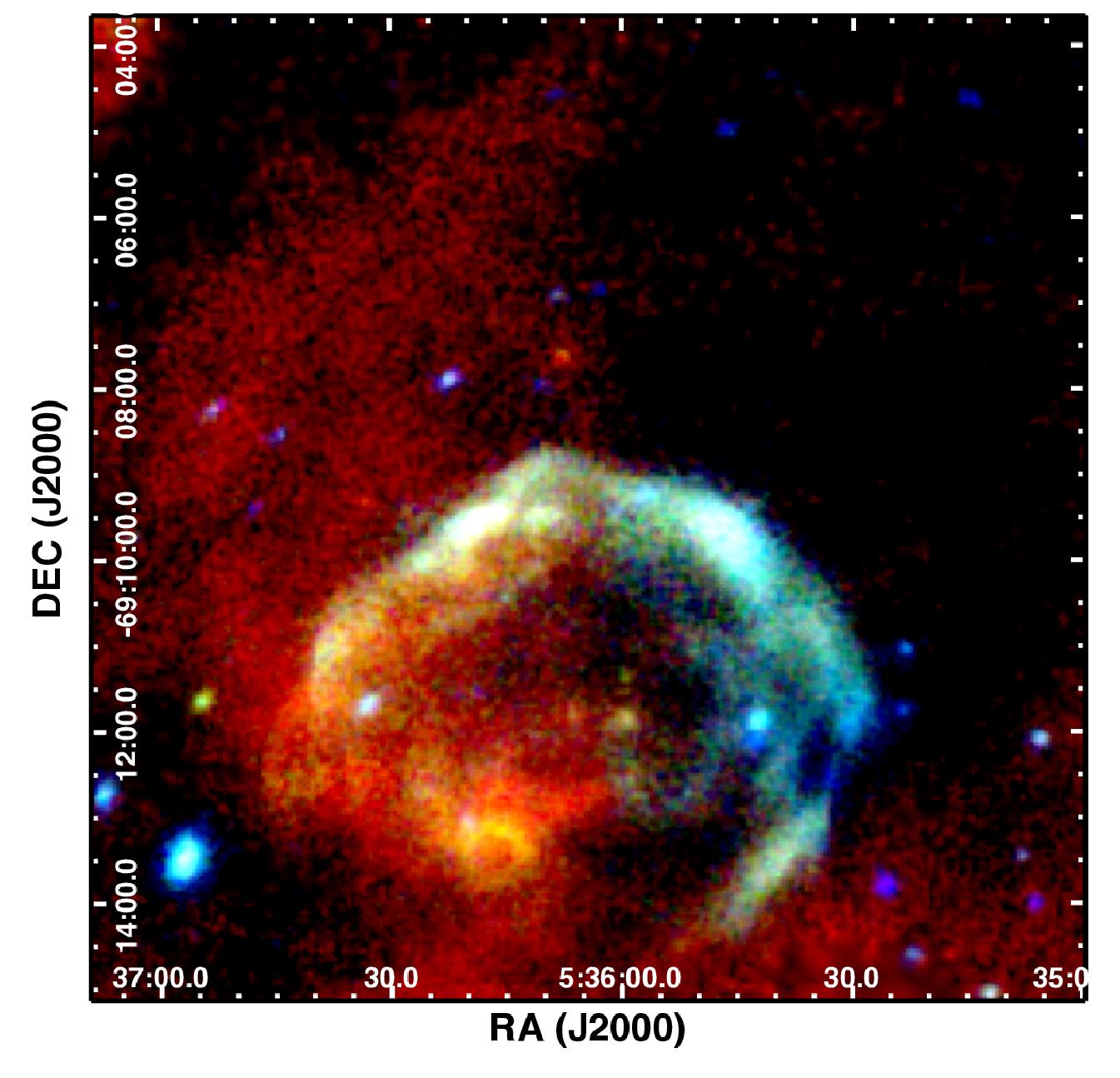
fig2
Fig. 2: XMM-Newton mosaic image (red: 0.3–1 keV, green: 1–2 keV, and blue: 2–7 keV, see [4]). Most of the X-ray emission has been found to be of non-thermal origin, which is very unusual for a superbubble.

This was in fact found to be true; after the first survey of the Large Magellanic Cloud was completed by H.E.S.S., 30 Dor C was indeed identified as one of the bright sources emitting Very High Energy gamma-rays, see [3]. This detection, combined with observations in X rays, has allowed us to explore the structure of the superbubble and understand the particle acceleration processes in this extreme region.
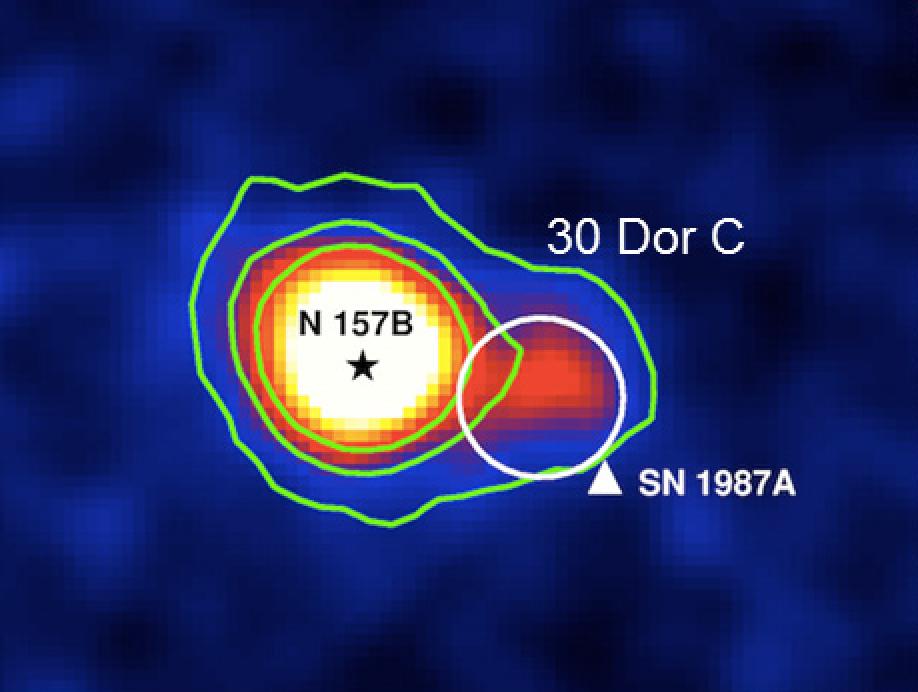
fig3
Fig. 3: The skymap of the central parts of the Large Magellanic Cloud shows two sources, the supernova remnant N157B and the fainter superbubble 30 Dor C ([3]). Just south of 30 Dor C the famous supernova 1987A exploded (but is not detected in the HESS map). The remnant of the SN1987A can be found in Figure 1.

The detection of the very high energy gamma-rays directly reveals that particles can obtain relativistic energies in the shocks in 30 Dor C. TeV emission can be caused by either the inverse Compton scattering of synchrotron photons on relativistic electrons or by the interaction of accelerated heavier particles (mainly protons) with the ambient dense medium. Deep observations with XMM-Newton have confirmed that non-thermal X-ray emission dominates in the entire superbubble, even in regions, in which additional thermal emission is detected. New studies at higher energies (up to 20 keV) with NuSTAR have also confirmed the non-thermal nature of the X-ray shell ([5]). Recent observations with the Chandra X-ray Observatory have additionally allowed us to measure the size of the regions that produce the synchrotron photons; these X-ray filaments have widths ranging from ~3″ to 20″. Assuming that the filament width is defined by the synchrotron loss time of advected electrons, the magnetic field strengths behind the shock are 20 micro-Gauss for the thin filaments and as low as 2.5 micro-Gauss in the broader filaments ([6]). The magnetic field strengths derived from Chandra data together with the VHE emission measured with H.E.S.S. is consistent with TeV emission being inverse Compton emission from electrons that have been accelerated in the winds of the young massive stars, in turbulences caused by the combination of the winds, and possibly in recent supernovae that occurred inside the superbubble. In addition, the X-ray spectra obtained with Chandra, NuSTAR and XMM and the spectral data taken with H.E.S.S. provide tight constraints on the energy spectra of the accelerated electrons.
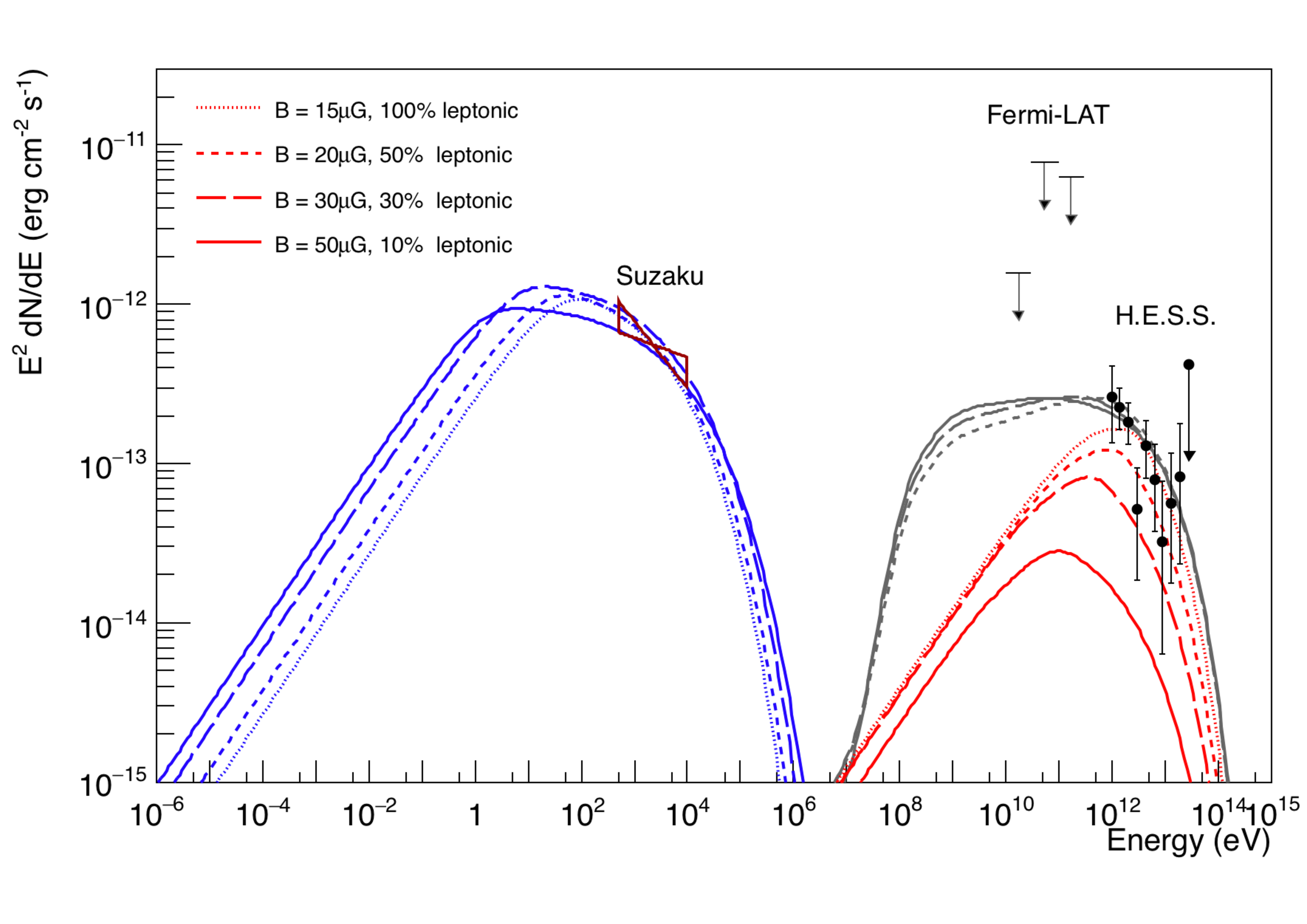
fig4
Fig. 4: The spectral energy distribution (SED) displays the amount of energy received from 30 DorC in the X-ray band (a butterfly represents observations obtained with the Suzaku instrument) and in HESS observations (taken from [4], as adapted from [3]). While the synchrotron emission (shown in blue) for a range of parameters are rather degenerate, the Inverse Compon emission (shown in red) enables a clear distinction. Models shown in black represent more complex, so-called hybrid models that include gamma-ray emission from hadronic processes.

References

[1] Le Marne, A. E. 1968, MNRAS, 139, 461

[2] Mathewson, D.S., Ford, V.L., Tuohy, I.R., et al. 1985, ApJS, 58, 197

[3] H.E.S.S. Collaboration, Abramowski, A., et al., 2015, Science, 347, 406

[4] Kavanagh, P.J., Sasaki, M., Bozzetto, L.M., et al., 2015, A&A, 573, 73

[5] Lopez, L.A., Greiffenstette, B.W., Auchettl, K., et al., 2020, ApJ, 893, 144

[6] Kavanagh, P.J., Vink, J., Sasaki, M., et al., 2019, A&A, 621, 138
Previous articleStriking a Jet -and Pinpointing the FlameNext article Mini Black Holes in the Atmosphere?

Sources of the month

Each month a TeV gamma ray source investigated with the H.E.S.S. telescopes is featured. See also the pages on Astrophysics with H.E.S.S.: The Nonthermal Universe with an overview of the physics and the source types.

Latest sources

The Vela Pulsar – the most Highly Energetic ClockNovember 1, 2023
HESS J1645−455 – A gem on the ring?October 1, 2023
The identity crisis of the blazar PKS 1510-089August 1, 2023

Tags

Atmosphere (1) black holes (2) Blazar (1) Cosmic rays (1) Extragalactic (2) Galactic Center (1) galactic plane (3) galactic source (1) Gamma-ray binary (2) gamma-rays (3) neutrinos (1) Nova (1) pulsar (1)

Contact

You can contact us for scientific queries and general information using:
contact.hess@hess-experiment.eu

Data Privacy Statement

https://www.mpi-hd.mpg.de/mpi/de/datenschutzhinweis
H.E.S.S. collaboration official website. Proudly Built By H.E.S.S. members.
(c) 2004-2025 by the H.E.S.S. collaboration

Last sources of the month

The Vela Pulsar – the most Highly Energetic ClockNovember 1, 2023
HESS J1645−455 – A gem on the ring?October 1, 2023
The identity crisis of the blazar PKS 1510-089August 1, 2023

Internal

  • Log in
  • Entries feed
  • Comments feed
  • WordPress.org
H.E.S.S. Collaboration
Manage Consent
To provide the best experiences, we use technologies like cookies to store and/or access device information. Consenting to these technologies will allow us to process data such as browsing behavior or unique IDs on this site. Not consenting or withdrawing consent, may adversely affect certain features and functions.
Functional Always active
The technical storage or access is strictly necessary for the legitimate purpose of enabling the use of a specific service explicitly requested by the subscriber or user, or for the sole purpose of carrying out the transmission of a communication over an electronic communications network.
Preferences
The technical storage or access is necessary for the legitimate purpose of storing preferences that are not requested by the subscriber or user.
Statistics
The technical storage or access that is used exclusively for statistical purposes. The technical storage or access that is used exclusively for anonymous statistical purposes. Without a subpoena, voluntary compliance on the part of your Internet Service Provider, or additional records from a third party, information stored or retrieved for this purpose alone cannot usually be used to identify you.
Marketing
The technical storage or access is required to create user profiles to send advertising, or to track the user on a website or across several websites for similar marketing purposes.
Manage options Manage services Manage {vendor_count} vendors Read more about these purposes
View preferences
{title} {title} {title}