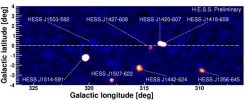
H.E.S.S. CollaborationH.E.S.S. Collaboration
  • About H.E.S.S.
    • H.E.S.S. Collaboration
      • Organisation
    • H.E.S.S. Science
    • H.E.S.S. Telescopes
    • H.E.S.S. Prize
  • News
    • Announcements
    • Press releases
    • Archival news
  • Source of the month
  • For scientists
    • Publications
      • Journals
      • Conferences
      • Astronomers Telegram
    • External Proposals
      • Visibility calculator
    • GRB observation schedule
    • Public test data release
    • Telescope specifications
  • Contact
November 1, 2009 by H.E.S.S. Collaboration
Source of the Month

Discovery of VHE Gamma-Ray Emission of a Remarkable Young Composite SNR

Discovery of VHE Gamma-Ray Emission of a Remarkable Young Composite SNR
November 1, 2009 by H.E.S.S. Collaboration
Source of the Month

November 2009

fig0

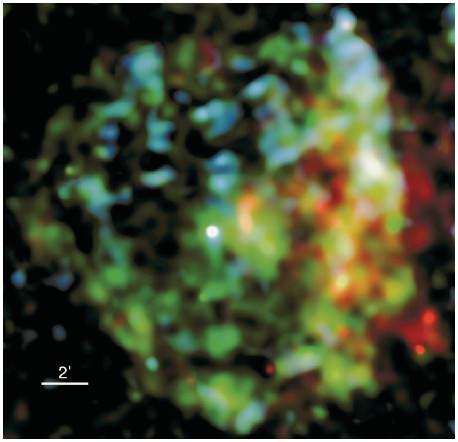
XMM-Newton X-ray image of  supernova remnant G292.2-0.5 and, at its center, pulsar PSR J1119-6127. Colors encode X-ray energies: 0.3-1.5 keV (red), 1.5-3.0 keV (green) and 3.0-10.0 keV (blue). From Gonzalez et al. (2005).


The high rate of change of the rotation period, however, points to a rapid loss of rotational energy caused by the high magnetic field of 4.1 x 10^13 Gauss, The pulsar PSR J1119-6127 was discovered in 1997 in a survey of the Galactic plane using the Parkes radio telescope in Australia (Camilo et al. 2000). This pulsar is characterized by an unusually high surface magnetic field of 4.1 x 10^13 Gauss, similar to the pulsar PSR J1846-0258 (Kes 75) – another VHE gamma ray source – and among the highest field strengths yet observed among young and energetic radio pulsars, intermediate between ‘normal’ pulsars and magnetars. The large magnetic field combined with the – relatively normal – rotation period of 0.4 sec results in a high loss rate of rotational energy. The age since birth of the pulsar is estimated to less than 1700 years. In observations with the ATCA radio telescope array,  Crawford et al. (2001) discovered a 15 arcminute diameter supernova shell (Fig. 1), labeled SNR G292.2-0.5., and presumably resulting from the stellar explosion in which the pulsar was born. The distance to pulsar and shell were estimated to about 5 kpc, with very large uncertainty, implying a diameter of the shell of order 10 pc and age of the shell of a few 1000 years, compatible with the estimated age of the pulsar. X-ray emission from the pulsar was first reported by Pivovaroff et al. (2001) using archival ROSAT data and ASCA data, but it required high-resolution imaging using Chandra to resolve the X-ray nebula surrounding the pulsar (Gonzales & Safi-Harb 2003) and to discover the jet-like structures emerging from the pulsar (Fig. 2)(Safi-Harb & Kumar (2008)). Similar jet-like features are seen near many pulsars, including the Crab pulsar. The supernova shell is also nicely seen in the XMM-Newton X-ray data of Gonzalez et al. (2005) (top image), in which for the first time pulsed X-ray emission was detected.

The large loss of rotational energy of the pulsar, a few 10^36 ergs/s, makes this composite supernova remnant an interesting target for observations with H.E.S.S., and indeed hints for a very high energy gamma ray signal were seen in data of the H.E.S.S. Galactic Plane Survey. In follow-up observations for a total observation time of about 50 h, a TeV gamma-ray source coincident with PSR J1119-6127 and G292.2-0.5 was confirmed (Fig. 3). The emission region is extended compared to the point spread function of H.E.S.S., and the flux is about 4% of the flux from the Crab nebula. The centroid of the emission is offset from the pulsar in the West/South-West direction, overlapping with a region of increased X-ray emission from the shell (top image), which might be attributed to interaction of the supernova shock with ambient material, or both. The origin of the TeV emission is not yet uniquely identified; it could either be attributed to an offset pulsar wind nebula as seen for many pulsars, or to particles accelerated in the shell and interacting with ambient gas.

Reference: A. Djannati-Atai et al., H.E.S.S. Collaboration, “HESS discovery of VHE gamma-ray emission of a remarkable young composite SNR“, Talk at the Workshop “Supernova Remnants and Pulsar Wind Nebulae in the Chandra Era”, 2009
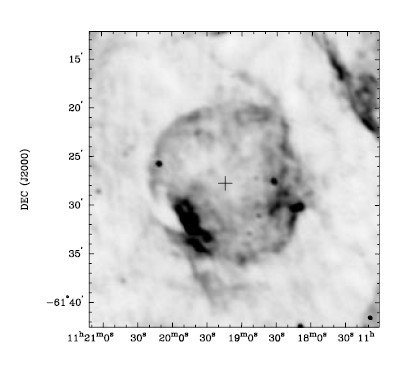
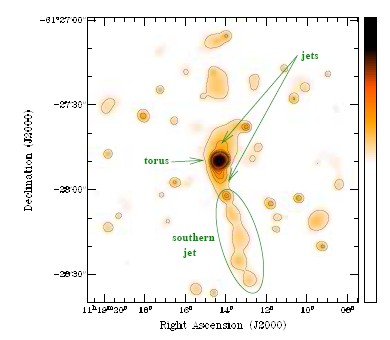
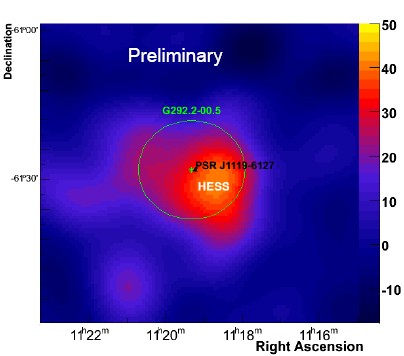
fig1

Fig. 1: Discovery of the supernova remnant G292.2-0.5 in radio observations at 1.4 GHz with ATCA (Crawford et al. 2001).

fig2

Fig. 2: Chandra observations reveal an extended pulser wind nebula surrounding the pulsar PSR J1119-6127, as well as indications of jets (Safi-Harb & Kumar 2008)

fig3

Fig. 3: H.E.S.S. gamma-ray image of the region of SNR G292.5-0.5 and PSR J1119-6127. The significance of the gamma-ray signal is about 8 sigma.

Previous articleHESS J1507-622 - an Unidentified Source off the Galactic PlaneNext article Five years later: VHE emission from the Galactic Center

Sources of the month

Each month a TeV gamma ray source investigated with the H.E.S.S. telescopes is featured. See also the pages on Astrophysics with H.E.S.S.: The Nonthermal Universe with an overview of the physics and the source types.

Latest sources

The Vela Pulsar – the most Highly Energetic ClockNovember 1, 2023
HESS J1645−455 – A gem on the ring?October 1, 2023
The identity crisis of the blazar PKS 1510-089August 1, 2023

Tags

Atmosphere (1) black holes (2) Blazar (1) Cosmic rays (1) Extragalactic (2) Galactic Center (1) galactic plane (3) galactic source (1) Gamma-ray binary (2) gamma-rays (3) neutrinos (1) Nova (1) pulsar (1)

Contact

You can contact us for scientific queries and general information using:
contact.hess@hess-experiment.eu

Data Privacy Statement

https://www.mpi-hd.mpg.de/mpi/de/datenschutzhinweis
H.E.S.S. collaboration official website. Proudly Built By H.E.S.S. members.
(c) 2004-2025 by the H.E.S.S. collaboration

Last sources of the month

The Vela Pulsar – the most Highly Energetic ClockNovember 1, 2023
HESS J1645−455 – A gem on the ring?October 1, 2023
The identity crisis of the blazar PKS 1510-089August 1, 2023

Internal

  • Log in
  • Entries feed
  • Comments feed
  • WordPress.org
H.E.S.S. Collaboration
Manage Consent
To provide the best experiences, we use technologies like cookies to store and/or access device information. Consenting to these technologies will allow us to process data such as browsing behavior or unique IDs on this site. Not consenting or withdrawing consent, may adversely affect certain features and functions.
Functional Always active
The technical storage or access is strictly necessary for the legitimate purpose of enabling the use of a specific service explicitly requested by the subscriber or user, or for the sole purpose of carrying out the transmission of a communication over an electronic communications network.
Preferences
The technical storage or access is necessary for the legitimate purpose of storing preferences that are not requested by the subscriber or user.
Statistics
The technical storage or access that is used exclusively for statistical purposes. The technical storage or access that is used exclusively for anonymous statistical purposes. Without a subpoena, voluntary compliance on the part of your Internet Service Provider, or additional records from a third party, information stored or retrieved for this purpose alone cannot usually be used to identify you.
Marketing
The technical storage or access is required to create user profiles to send advertising, or to track the user on a website or across several websites for similar marketing purposes.
Manage options Manage services Manage {vendor_count} vendors Read more about these purposes
View preferences
{title} {title} {title}