H.E.S.S. CollaborationH.E.S.S. Collaboration
  • About H.E.S.S.
    • H.E.S.S. Collaboration
      • Organisation
    • H.E.S.S. Science
    • H.E.S.S. Telescopes
    • H.E.S.S. Prize
  • News
    • Announcements
    • Press releases
    • Archival news
  • Source of the month
  • For scientists
    • Publications
      • Journals
      • Conferences
      • Astronomers Telegram
    • External Proposals
      • Visibility calculator
    • GRB observation schedule
    • Public test data release
    • Telescope specifications
  • Contact
August 1, 2009 by H.E.S.S. Collaboration
Source of the Month

An Extended Source of Gamma Rays near PSR B1706-44

An Extended Source of Gamma Rays near PSR B1706-44
August 1, 2009 by H.E.S.S. Collaboration
Source of the Month

August 2009

fig0

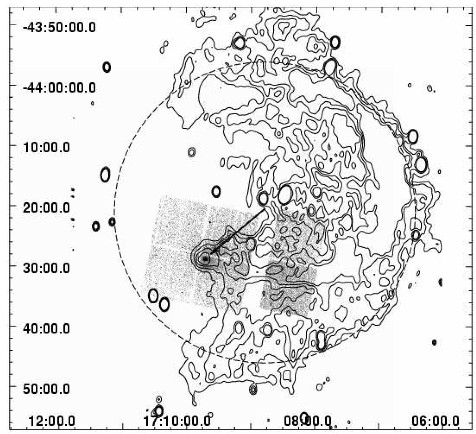
Chandra X-ray image (greyscale) superimposed on a 1384 MHz ATCA radio image of the shell of the supernova remnant G343.1-2.3 (from Romani et al. 2005). The approximate boundary of the remnant is marked by the dashed line. The pulsar PSR B1706-44 is located near the tip of the arrow, and the arrow itself represents the motion required for the pulsar in the case where it was created at the center of the remnant.


The pulsar PSR B1706-44 (see ATNF pulsar catalog) is in a number of respects an enigmatic object. With a spin period of 102 ms, an age of about 17,500 years, a rather high spin-down luminosity, and a distance estimated in the 2-3 kpc range, it belongs to the class of relatively young and powerful pulsars which are prime candidates as very-high-energy (VHE) gamma-ray sources. Indeed, the pulsar is surrounded by a 2-3 arcminute nebula of sychrotron emission from high-energy electrons, detectable in the radio (Giacani et al. 2001) as well as in X-rays (Gotthelf et al. 2002). Detailed studies with Chandra revealed evidence for a termination shock of an equatorial pulsar wind and for polar jets, embedded in the pulsar wind nebula (Fig. 1, Romani et al. 2005). EGRET detected strong pulsed emission at GeV energies (Thompson et al. 1996).

The region of PSR B1706-44 was detected as a source of TeV gamma rays with the CANGAROO 3.8 m telescope (Kifune et al. 1995); the detection of an unpulsed flux of VHE gamma rays was confirmed a few years later by the Durham Mark 6 telescope (Chadwick et al. 1998). First observations of the region with the H.E.S.S. telescopes during the commissioning phase in 2003, however, failed to reveal a VHE gamma-ray source, and flux limits obtained were an order of magnitude below the reported flux (Aharonian el al. 2005). The story continues in 2009, when a reanalysis of the old CANGAROO 3.8 m data revealed problems with the earlier processing of the data and failed to reproduce the signal (Yoshikoshi et al. 2009). At the International Cosmic Ray Conference 2009 in Lodz, both H.E.S.S. (Hoppe et al. 2009), see Fig. 2 and Fig. 3, and the CANGAROO III telescope system (Enomoto et al. 2009) reported detection of extended VHE gamma-ray emission from the region near the pulsar. However, once more the results are not fully consistent. The source as reconstructed based on H.E.S.S. observations has a (Gaussian) width of 0.3 degrees and a flux of about 17% of the Crab flux, whereas Enomoto et al. find a considerably larger and stronger source, more of less filling the entire field of view; the difference may be related to the way the background under the signal is estimated and subtracted.

Given the extended nature of the source, it is unclear if the emission is to be associated with the pulsar PSR B1706-44 – located at the edge of the H.E.S.S. source – or with the supernova remnant G343.1-2.3, in which the pulsar is thought to be embedded. Based on energetics and information in other wavebands, neither interpretation can be excluded (Hoppe et al. 2009). Furthermore, it is not even clear if the pulsar and the remnant are associated in that both result from the same supernova explosion. The off-center position of the pulsar relative to the radio arc of the remnant implies a very high proper motion of the pulsar (the arrow in the top image), incompatible with other estimates of the pulsar’s motion (Nicastro 1996); on the other hand, Bock and Gavamadze (2002) argued that the visible radio shell might be deformed by interaction with a molecular cloud. Clearly, only better data in all wavebands can help to address the many open questions surrounding PSR B1706-44 / G343.1-2.3.

Reference: S. Hoppe et al., “Detection of very-high-energy gamma-ray emission from the vicinity of PSR B1706-44 with H.E.S.S”, Proceedings of the 31st International Cosmic Ray Conference, Lodz, 2009, and arXiv:0906.5574.
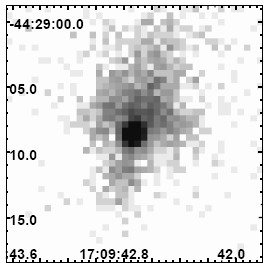
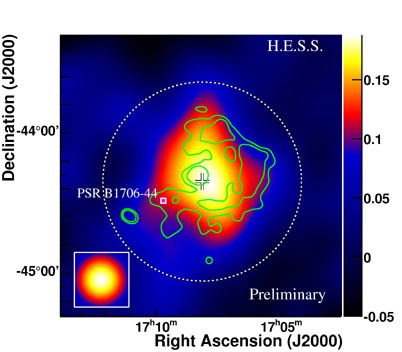
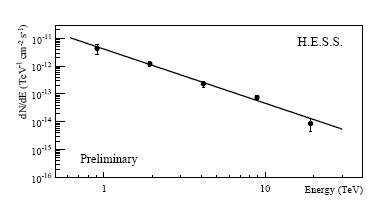
fig1

Fig. 1: Inner region of the X-ray nebula, interpreted as a toroidal wind termination shock surrounding the pulsar – the dark spot at the center – plus polar jets emerging from the pulsar.

fig2

Fig. 2: Gamma-ray sky map of the source HESS J1708-443, smoothed with a Gaussian of 0.15 degr. width; the effective point-spread function of the telescopes is also shown (inlay). The pulsar (small square) is at the edge of the gamma-ray emission region; the centroid of the gamma-ray emission is displaced from the pulsar by about 0.3 degr. Contours of constant radio intensity as seen at 330 MHz with the VLA are superimposed in green.

fig3

Fig. 3: The energy spectrum of gamma rays from HESS J1708-443 is unusually hard, with a spectral index of 2.0, and extends up to 20 TeV.

Previous articleThe Westerlund 1 Star ClusterNext article HESS J1507-622 - an Unidentified Source off the Galactic Plane

Sources of the month

Each month a TeV gamma ray source investigated with the H.E.S.S. telescopes is featured. See also the pages on Astrophysics with H.E.S.S.: The Nonthermal Universe with an overview of the physics and the source types.

Latest sources

The Vela Pulsar – the most Highly Energetic ClockNovember 1, 2023
HESS J1645−455 – A gem on the ring?October 1, 2023
The identity crisis of the blazar PKS 1510-089August 1, 2023

Tags

Atmosphere (1) black holes (2) Blazar (1) Cosmic rays (1) Extragalactic (2) Galactic Center (1) galactic plane (3) galactic source (1) Gamma-ray binary (2) gamma-rays (3) neutrinos (1) Nova (1) pulsar (1)

Contact

You can contact us for scientific queries and general information using:
contact.hess@hess-experiment.eu

Data Privacy Statement

https://www.mpi-hd.mpg.de/mpi/de/datenschutzhinweis
H.E.S.S. collaboration official website. Proudly Built By H.E.S.S. members.
(c) 2004-2025 by the H.E.S.S. collaboration

Last sources of the month

The Vela Pulsar – the most Highly Energetic ClockNovember 1, 2023
HESS J1645−455 – A gem on the ring?October 1, 2023
The identity crisis of the blazar PKS 1510-089August 1, 2023

Internal

  • Log in
  • Entries feed
  • Comments feed
  • WordPress.org
H.E.S.S. Collaboration
Manage Consent
To provide the best experiences, we use technologies like cookies to store and/or access device information. Consenting to these technologies will allow us to process data such as browsing behavior or unique IDs on this site. Not consenting or withdrawing consent, may adversely affect certain features and functions.
Functional Always active
The technical storage or access is strictly necessary for the legitimate purpose of enabling the use of a specific service explicitly requested by the subscriber or user, or for the sole purpose of carrying out the transmission of a communication over an electronic communications network.
Preferences
The technical storage or access is necessary for the legitimate purpose of storing preferences that are not requested by the subscriber or user.
Statistics
The technical storage or access that is used exclusively for statistical purposes. The technical storage or access that is used exclusively for anonymous statistical purposes. Without a subpoena, voluntary compliance on the part of your Internet Service Provider, or additional records from a third party, information stored or retrieved for this purpose alone cannot usually be used to identify you.
Marketing
The technical storage or access is required to create user profiles to send advertising, or to track the user on a website or across several websites for similar marketing purposes.
Manage options Manage services Manage {vendor_count} vendors Read more about these purposes
View preferences
{title} {title} {title}