H.E.S.S. CollaborationH.E.S.S. Collaboration
  • About H.E.S.S.
    • H.E.S.S. Collaboration
      • Organisation
    • H.E.S.S. Science
    • H.E.S.S. Telescopes
    • H.E.S.S. Prize
  • News
    • Announcements
    • Press releases
    • Archival news
  • Source of the month
  • For scientists
    • Publications
      • Journals
      • Conferences
      • Astronomers Telegram
    • External Proposals
      • Visibility calculator
    • GRB observation schedule
    • Public test data release
    • Telescope specifications
  • Contact
April 1, 2006 by H.E.S.S. Collaboration
Source of the Month

The Wings of the Kookaburra

The Wings of the Kookaburra
April 1, 2006 by H.E.S.S. Collaboration
Source of the Month

April 2006

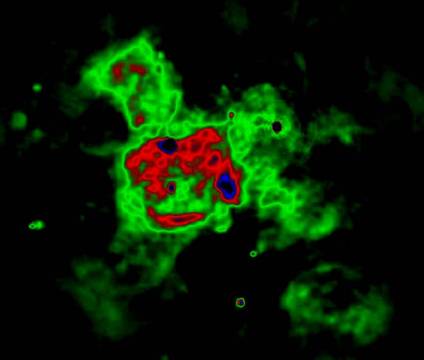
adio image at 20 cm wavelength (Roberts et al. 1999) of a region near the Galactic Plane around 313o longitude, showing a complex of radio sources extending over a square degree. The ensemble of sources was named the “Kookaburra”, after the Australian bird. Radiation from the circular “body” of the Kookaburra seems mostly thermal radiation from heated gas. The two “wings” of the Kookaburra are also X-ray sources (Roberts et al. 1999, Ng et al. 2005) and the emission from these regions is probably caused by high-energy electrons. The upper (north) wing hosts the pulsar PSR J1420-6048 (D’Amico et al. 2001), located at the lower of the three small red spots, which could be feeding electrons into the wing region. Of the two bright (blue) regions in the body, the upper one (G313.5+0.2) is a H II region. The lower bright region is known as the “Rabbit” and is also an X-ray source. Two other regions of high radio flux, the “eye” of the Kookaburra (G313.2+0.2) and the compact source near the center of the body (G313.4+0.1) are most likely unrelated extragalactic objects.


Interest in the region around Galactic longitude 313o arose initially since it contains unidentified EGRET gamma-ray sources emitting in the energy range of tens of MeV to GeV. The EGRET sources have a long history; first reported as 2EGS J1418-6049 in the supplement to the 2nd EGRET catalog (Thompson et al. 1996), a source was then recognized as the GeV source GeV J1417-6100 at a slightly different position (Lamb and Macomb 1997), and was in the 3rd EGRET catalog resolved into two sources, 3EG J1420−6038 and 3EG J1410-6147 (Hartman et al. 1999). Observations in radio and X-rays revealed the complex structure shown above, composed of a mixture of compact and extended radio sources and X-ray sources (Roberts et al. 1999). In the north wing of the Kookaburra,D’Amico et al. 2001 discovered the radio pulsar PSR J1420-6048 at a distance of 5.6 kpc, which presumably is one of the sources energizing the complex (Roberts et al. 2001). High-resolution X-ray imaging showed an X-ray nebula surrounding the pulsar. The southern source – the “Rabbit” – was resolved into two X-ray sources, on of them again surrounded by an X-ray nebula (Ng et al. 2005), with a marginal detection of pulsed emission. Hence, the Rabbit is probably also a pulsar wind nebula.

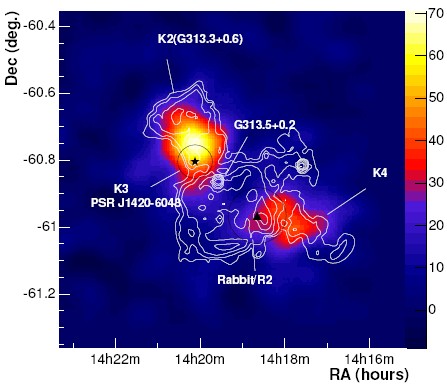
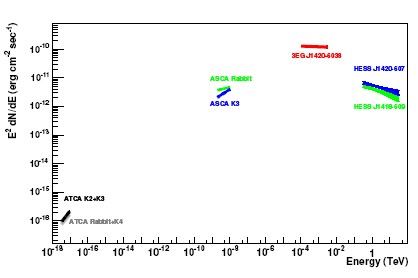
First H.E.S.S. data on the Kookaburra region were gathered as part of an extension of theH.E.S.S. Galactic Plane survey between April and July 2005, covering the longitude range from 300o to 330o. An initial gamma-ray signal triggered further observations between May and August 2005, resulting in a total data set of 18 h. The H.E.S.S. sky map reveals two clearly separated sources in the Kookaburra region (Fig. 1), HESS J1420-607 and HESS J1418-609, with a statistical significance of 15 and 13 standard deviations, respectively.  The two sources coincide with the wings of the Kookaburra as seen in Radio (Fig. 2), and are slightly offset from the X-ray sources at PSR J1420-6047 and the Rabbit, respectively. Since an offset morphology of TeV pulsar wind nebulae with respect to the pulsar location is not unusual (see e.g. September 2005), is seems rather likely that the X-ray nebulae and the TeV emission have a common origin and are fed by pulsar winds. Indeed, both TeV sources are extended objects, with a (Gaussian) width of 3′-4′, corresponding to a characteristic size around 10 pc (assuming 5 kpc distance). Both sources exhibit power-law gamma ray spectra between 300 GeV and 30 TeV, with similar spectral indices and a flux of order 10% of the flux from the Crab Nebula; the northern source is slightly more intense. The wide-band spectral energy distribution is illustrated in Fig. 3 and includes the EGRET source 3EG J1420−6038 which, due to the poor location precision, could be associated with either of the two TeV sources, or represent a superposition of two unresolved sources. The gaps in spectral coverage do not allow a clear statement if the EGRET source is really associated with the X-ray and TeV emission; they leave much freedom for the detailed interpretation and call for further observations with present and future instruments.

These new TeV pulsar wind nebulae (PWN) together with other H.E.S.S. sources illustrate that PWN which are offset from their pulsars are quite abundant, and probably account for a significant fraction of all Galactic TeV sources. This is not so surprising; compared to supernova shock waves as cosmic particle accelerators, PWN have the advantage of a longer lifetime, their power being continuously replenished by the pulsar, and of a more efficient conversion of particle energies into high-energy gamma rays by the inverse Compton mechanism.

References:

F. Aharonian et al., submitted.
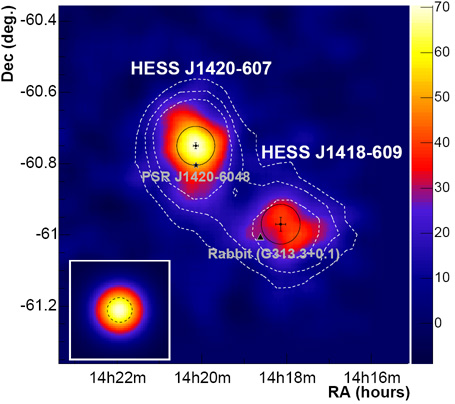

Fig. 1: H.E.S.S. sky map of the Kookaburra region, clearly showing two distinct TeV sources. Dashed contours correspond to 5, 7.5 and 10 standard deviation significance for an integration circle of 0.1o around a given position. The inset illustrates the H.E.S.S. point spread function including the effect of slight smoothing which was applied to the image. (Preliminary)

Fig. 2: TeV emission as shown in Fig. 1, together with the radio contours from Roberts et al. 1999. The TeV emission lines up with the wings of the Kookaburra (labeled K2/K3 and K4) and extends north of the pulsar wind nebula surrounding PSR J1420-6048 (K3) and west of the Rabbit. (Preliminary)

Fig. 3: Wide-band spectral energy distribution, including radio, X-ray and EGRET data (Roberts et al. 1999, Roberts et al. 2001, Hartman et al. 1999). Owing to the differences in angular resolution and analysis techniques, the regions over which flux is integrated are not fully identical for the different energy bands, hence it is not guaranteed that identical particle populations are probed. (Preliminary)

Previous articleHigh Energy Gamma Rays from the Galactic Center RidgeNext article Vela X - a Cosmic Accelerator

Sources of the month

Each month a TeV gamma ray source investigated with the H.E.S.S. telescopes is featured. See also the pages on Astrophysics with H.E.S.S.: The Nonthermal Universe with an overview of the physics and the source types.

Latest sources

The Vela Pulsar – the most Highly Energetic ClockNovember 1, 2023
HESS J1645−455 – A gem on the ring?October 1, 2023
The identity crisis of the blazar PKS 1510-089August 1, 2023

Tags

Atmosphere (1) black holes (2) Blazar (1) Cosmic rays (1) Extragalactic (2) Galactic Center (1) galactic plane (3) galactic source (1) Gamma-ray binary (2) gamma-rays (3) neutrinos (1) Nova (1) pulsar (1)

Contact

You can contact us for scientific queries and general information using:
contact.hess@hess-experiment.eu

Data Privacy Statement

https://www.mpi-hd.mpg.de/mpi/de/datenschutzhinweis
H.E.S.S. collaboration official website. Proudly Built By H.E.S.S. members.
(c) 2004-2025 by the H.E.S.S. collaboration

Last sources of the month

The Vela Pulsar – the most Highly Energetic ClockNovember 1, 2023
HESS J1645−455 – A gem on the ring?October 1, 2023
The identity crisis of the blazar PKS 1510-089August 1, 2023

Internal

  • Log in
  • Entries feed
  • Comments feed
  • WordPress.org
H.E.S.S. Collaboration
Manage Consent
To provide the best experiences, we use technologies like cookies to store and/or access device information. Consenting to these technologies will allow us to process data such as browsing behavior or unique IDs on this site. Not consenting or withdrawing consent, may adversely affect certain features and functions.
Functional Always active
The technical storage or access is strictly necessary for the legitimate purpose of enabling the use of a specific service explicitly requested by the subscriber or user, or for the sole purpose of carrying out the transmission of a communication over an electronic communications network.
Preferences
The technical storage or access is necessary for the legitimate purpose of storing preferences that are not requested by the subscriber or user.
Statistics
The technical storage or access that is used exclusively for statistical purposes. The technical storage or access that is used exclusively for anonymous statistical purposes. Without a subpoena, voluntary compliance on the part of your Internet Service Provider, or additional records from a third party, information stored or retrieved for this purpose alone cannot usually be used to identify you.
Marketing
The technical storage or access is required to create user profiles to send advertising, or to track the user on a website or across several websites for similar marketing purposes.
Manage options Manage services Manage {vendor_count} vendors Read more about these purposes
View preferences
{title} {title} {title}