H.E.S.S. CollaborationH.E.S.S. Collaboration
  • About H.E.S.S.
    • H.E.S.S. Collaboration
      • Organisation
    • H.E.S.S. Science
    • H.E.S.S. Telescopes
    • H.E.S.S. Prize
  • News
    • Announcements
    • Press releases
    • Archival news
  • Source of the month
  • For scientists
    • Publications
      • Journals
      • Conferences
      • Astronomers Telegram
    • External Proposals
      • Visibility calculator
    • GRB observation schedule
    • Public test data release
    • Telescope specifications
  • Contact
February 1, 2006 by H.E.S.S. Collaboration
Source of the Month

PG 1553+113 – the mystery AGN

PG 1553+113 – the mystery AGN
February 1, 2006 by H.E.S.S. Collaboration
Source of the Month

February 2006

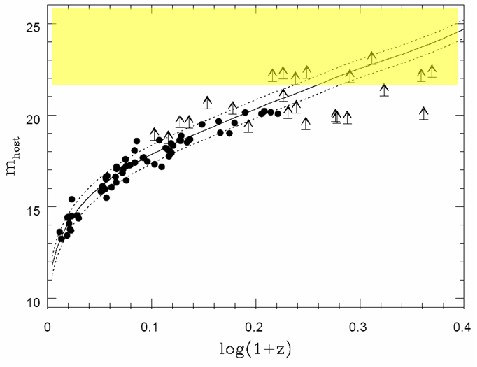
“Hubble diagram” for host galaxies of BL Lac objects, showing apparent magnitude versus redshift (Sbarufatti et al, 2005). The diagram can be used to estimate unknown redshifts if the brightness of the host galaxy is known. In case of the object PG 1553+113 discussed this month, the host galaxy cannot be detected and the upper limit on its brightness – only the yellow region is allowed – would place it at a rather large redshift.


The object PG 1553+113 was discovered in the Palomar-Green survey of stellar objects with excessive UV emission (Green et al. 1986). Since its spectrum does not exhibit prominent emission or absorption lines (Miller and Green, 1983, Falomo and Treves 1990) and since its brightness is variable, it was classified as a BL Lac object (Giommi et al. 1995), i.e. as an active galactic nucleus where most of the emission is attributed to a matter jet emerging from the central black hole, and pointed towards the observer. This classification is confirmed by X-ray emission (Perlman et al. 2005,Donato et al. 2005). A subject of long discussion, however, was the redshift of PG 1553+113, i.e. its distance. Initially, a redshift of z=0.36 was attributed by Miller and Green (1983) on the basis of a faint emission line.  Falomo and Treves (1990) pointed out that this “line” was a spurious flaw in the image, that was misidentified as the Lyman-alpha line. Even in images taken with 8 m class telescopes, no genuine lines were found. Also, no host galaxy could be resolved in images taken with the Hubble Space Telescope (Scarpa et al. 2000). For most “nearby” BL Lac objects, a host galaxy is detected (see top figure), and a lower limit on the redshift of z>0.78 was given by Sbarufatti et al, (2005) , making this a rather distant object.

On the basis of its flux in the X-ray and radio domains, PG 1553+113 was selected as an observation target for H.E.S.S. (seeNov. 2005, Fig. 1). This happened before the redshift limit z>0.78 was published; due to absorption of gamma rays in interactions with the infrared and optical radiation in the space between galaxies (see Dec. 2005), an object at such a distance should not be detectable. Surprisingly, a hint for very-high-energy gamma ray emission was found in the H.E.S.S. data (Fig. 1), initially with a significance of about 4 standard deviations,  increasing with more than 5 standard deviation when the selection criteria were optimized for steep-spectrum sources. Since high-energy gamma rays are more strongly absorbed, surviving gamma rays for very distant sources are expected to show a flux which rapidly decreases towards high energy. Indeed, the measured spectrum (Fig. 2), with a spectral index around 4, is among the steepest spectra ever measured in the TeV regime.

Based on the detection of two other active galaxies,1 ES 1101-232 and H 2356-309, the H.E.S.S. collaboration showed that there is less radiation in the space between galaxies than previously assumed (see Dec. 2005). The detection of PG 1553+113 – if indeed at a large redshift – dramatically supports this result. With radiation levels at the upper limit allowed from the earlier H.E.S.S. data, the redshift for a source with such a spectrum cannot exceed ~0.45 (Fig. 3), in conflict with the lower limit derived from the Hubble images. Only with radiation levels near the very minimum possible value, counting only light from known galaxies, a redshift up to ~0.65 to 0.75 is tolerable, marginally consistent with the Hubble limit of Sbarufatti et al, (2005). We note, however, that a recent analysis also based on the lack of detection of the host galaxy gives a more conservative lower redshift limit of z>0.09 (Sbarufatti et al., 2006). Obviously, efforts should be made to reliably establish the redshift of this interesting object!

References:

Evidence for VHE gamma-ray emission from the distant BL Lac PG 1553+113, F. Aharonian et al., Astronomy & Astrophysics, in press andastro-ph/0601545
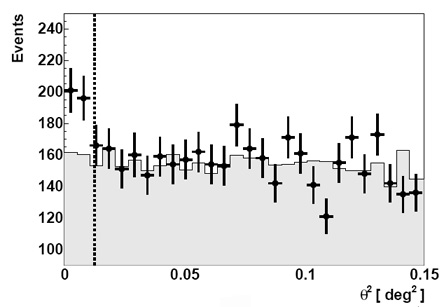
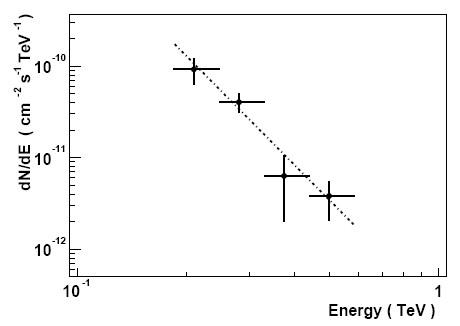
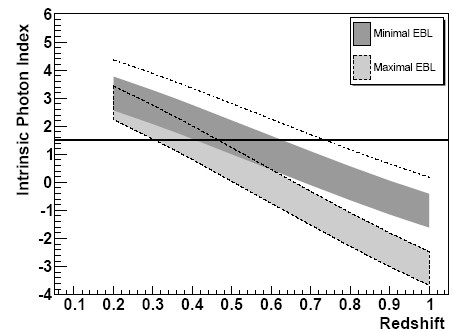
Fig. 1: Angular distribution of reconstructed gamma-ray directions relative to PG 1553+113. The shaded area shows the estimated background; the excess of 83 gamma rays at small angles corresponds to a statistical significance of 4 standard deviations.

Fig. 2: Measure energy spectrum of gamma rays; the lines shows a power-law fit with a spectral index of 4.0. The gamma-ray flux above 200 GeV corresponds roughly to 2% of the flux from the Crab Nebula

Fig. 3: Absorption in intergalactic space makes gamma ray spectra steeper. The graph shows the spectral index for the source (“intrinsic photon index” Gamma, defined via dN/dE ~ E-Gamma), required to match the observed spectrum once absorption is taken into account, as a function of the distance (i.e. redshift) of the source. Plotted are two scenarios for the density of radiation in interstellar space, “maximal” represents the upper limit derived using earlier H.E.S.S. results, whereas “minimal” includes only light levels based on galaxy counts. Plausible models for gamma ray production result in an intrinsic index which is 1.5 or larger. An upper limit for the redshift can therefore be derived as the point where the shaded bands fall below a value of 1.5.

Previous articleMultiwavelength observations of H2356-309Next article High Energy Gamma Rays from the Galactic Center Ridge

Sources of the month

Each month a TeV gamma ray source investigated with the H.E.S.S. telescopes is featured. See also the pages on Astrophysics with H.E.S.S.: The Nonthermal Universe with an overview of the physics and the source types.

Latest sources

The Vela Pulsar – the most Highly Energetic ClockNovember 1, 2023
HESS J1645−455 – A gem on the ring?October 1, 2023
The identity crisis of the blazar PKS 1510-089August 1, 2023

Tags

Atmosphere (1) black holes (2) Blazar (1) Cosmic rays (1) Extragalactic (2) Galactic Center (1) galactic plane (3) galactic source (1) Gamma-ray binary (2) gamma-rays (3) neutrinos (1) Nova (1) pulsar (1)

Contact

You can contact us for scientific queries and general information using:
contact.hess@hess-experiment.eu

Data Privacy Statement

https://www.mpi-hd.mpg.de/mpi/de/datenschutzhinweis
H.E.S.S. collaboration official website. Proudly Built By H.E.S.S. members.
(c) 2004-2025 by the H.E.S.S. collaboration

Last sources of the month

The Vela Pulsar – the most Highly Energetic ClockNovember 1, 2023
HESS J1645−455 – A gem on the ring?October 1, 2023
The identity crisis of the blazar PKS 1510-089August 1, 2023

Internal

  • Log in
  • Entries feed
  • Comments feed
  • WordPress.org
H.E.S.S. Collaboration
Manage Consent
To provide the best experiences, we use technologies like cookies to store and/or access device information. Consenting to these technologies will allow us to process data such as browsing behavior or unique IDs on this site. Not consenting or withdrawing consent, may adversely affect certain features and functions.
Functional Always active
The technical storage or access is strictly necessary for the legitimate purpose of enabling the use of a specific service explicitly requested by the subscriber or user, or for the sole purpose of carrying out the transmission of a communication over an electronic communications network.
Preferences
The technical storage or access is necessary for the legitimate purpose of storing preferences that are not requested by the subscriber or user.
Statistics
The technical storage or access that is used exclusively for statistical purposes. The technical storage or access that is used exclusively for anonymous statistical purposes. Without a subpoena, voluntary compliance on the part of your Internet Service Provider, or additional records from a third party, information stored or retrieved for this purpose alone cannot usually be used to identify you.
Marketing
The technical storage or access is required to create user profiles to send advertising, or to track the user on a website or across several websites for similar marketing purposes.
Manage options Manage services Manage {vendor_count} vendors Read more about these purposes
View preferences
{title} {title} {title}