
H.E.S.S. CollaborationH.E.S.S. Collaboration
  • About H.E.S.S.
    • H.E.S.S. Collaboration
      • Organisation
    • H.E.S.S. Science
    • H.E.S.S. Telescopes
    • H.E.S.S. Prize
  • News
    • Announcements
    • Press releases
    • Archival news
  • Source of the month
  • For scientists
    • Publications
      • Journals
      • Conferences
      • Astronomers Telegram
    • External Proposals
      • Visibility calculator
    • GRB observation schedule
    • Public test data release
    • Telescope specifications
  • Contact
November 1, 2005 by H.E.S.S. Collaboration
Source of the Month

PKS 2005-489 – the first new AGN discovered by H.E.S.S.

PKS 2005-489 – the first new AGN discovered by H.E.S.S.
November 1, 2005 by H.E.S.S. Collaboration
Source of the Month

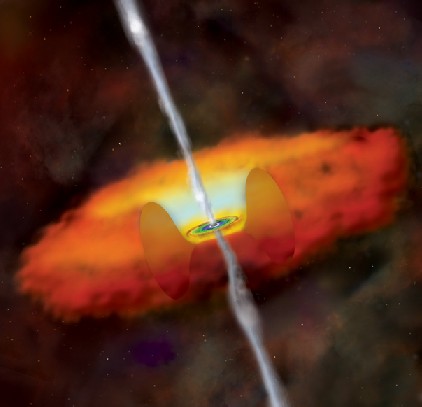
An artist’s view of the central region of an active galaxy shows a supermassive black hole surrounded by a disk of hot gas, and a large doughnut or torus of cooler gas and dust. The light blue ring on the back of the torus is due to the fluorescence of iron atoms excited by X-rays from the hot gas disk. Jets of high energy particles (white) are propelled away from the vicinity of the black hole by intense electric and magnetic fields. Presumable in shock waves in these jets, electrons are accelerated to high energies and, when colliding with photons, create high energy gamma rays. The  gamma ray emission is collimated along the axis of the jet, and can usually only be observed when the jet points towards Earth. (Source: NASA/CXC/M.Weiss)


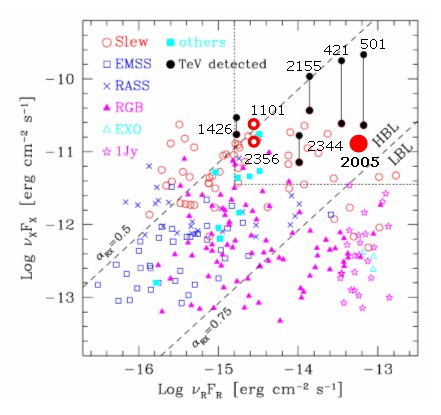
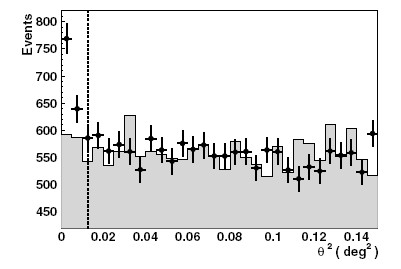
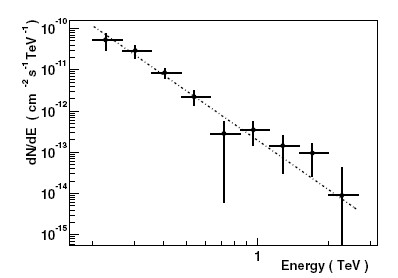
The winter months are the main observing season for extragalactic objects for H.E.S.S., hence we will here and in the next SOM’s concentrate on extragalactic sources of TeV gamma rays. PKS 2005-489 is in a certain sense of historical interest, being the first active galactic nucleus (AGN) newly discovered by H.E.S.S., based on data partly taken during the commissioning phase with two and three telescopes. The object was selected as an interesting candidate for observation on the basis of its high flux in X-rays and at radio wavelengths (Fig. 1), both tracers of high-energy electrons. H.E.S.S. observations resulted in a detection with a significance of 6 standard deviations (Fig. 2), sufficiently strong to derive an energy spectrum (Fig. 3). Attemps to detect the object with previous instruments had failed (Roberts et al. 1999, Nishijima et al. 2002, Chadwick et al. 2000), which is not surprising given its small gamma ray flux, of only 2.5% of the Crab Nebula flux. During the H.E.S.S. observations, X-ray activity of PKS 2005-489 was rather low in comparison to earlier times (e.g. 1998), implying that the AGN was in a low-emission state. Given its relatively modest redshift of 0.071, the steep energy spectrum appears to be an intrinsic feature of the source – the acceleration engine running out of steam – opposed to effects caused by gamma-ray absorption due to interactions with photons in extragalactic space, which preferentially remove high-energy particles.
The object PKS 2005-489 was observed again with H.E.S.S.  in 2005, resulting in a strong detection and confirming the earlier results. A detailed analysis of this data and of simultaneous measurements at other wavelengths is still in progress.
Discovery of VHE gamma rays from PKS 2005-489, F. Aharonian et al., Astron. Astrophys. 436 (2005) L17-L20
References:


Fig. 1: The selection of extragalactic observation targets relies strongly on this plot of X-ray intensity versus radio intensity for a special type of active galactic nuclei (AGN), the BL Lac objects (Costamante & Ghisellini, 2002). These objects have their jet pointing towards us. Virtually all active galaxies detected previously at TeV energies (full black points) belong to this class and are characterized by high X-ray and radio flux, indicative of the presence of high-energy electrons in the source. Scattering off ambient or synchrotron photons, these electrons produce TeV gamma rays. PKS 2005-489 is indicated by the filled red circle, other new H.E.S.S. AGN sources – to be presented later in this series – by the open red circles.

Fig. 2: Angular distribution of gamma-ray candidates relative to the direction towards PKS 2005-489. The shaded area shows the background estimate. The significance of the peak at the source is more than 6 standard deviations.

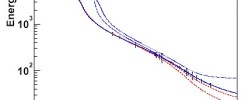
Fig. 3: Energy spectrum of gamma rays from PKS 2005-489. The spectrum is well represented by a power law with index Γ=4.

Previous articleMarkarian 421 - a Fresh Look at a Familiar SourceNext article The Blazar 1ES 1101-232 and the Gamma Ray Horizon

Sources of the month

Each month a TeV gamma ray source investigated with the H.E.S.S. telescopes is featured. See also the pages on Astrophysics with H.E.S.S.: The Nonthermal Universe with an overview of the physics and the source types.

Latest sources

The Vela Pulsar – the most Highly Energetic ClockNovember 1, 2023
HESS J1645−455 – A gem on the ring?October 1, 2023
The identity crisis of the blazar PKS 1510-089August 1, 2023

Tags

Atmosphere (1) black holes (2) Blazar (1) Cosmic rays (1) Extragalactic (2) Galactic Center (1) galactic plane (3) galactic source (1) Gamma-ray binary (2) gamma-rays (3) neutrinos (1) Nova (1) pulsar (1)

Contact

You can contact us for scientific queries and general information using:
contact.hess@hess-experiment.eu

Data Privacy Statement

https://www.mpi-hd.mpg.de/mpi/de/datenschutzhinweis
H.E.S.S. collaboration official website. Proudly Built By H.E.S.S. members.
(c) 2004-2025 by the H.E.S.S. collaboration

Last sources of the month

The Vela Pulsar – the most Highly Energetic ClockNovember 1, 2023
HESS J1645−455 – A gem on the ring?October 1, 2023
The identity crisis of the blazar PKS 1510-089August 1, 2023

Internal

  • Log in
  • Entries feed
  • Comments feed
  • WordPress.org
H.E.S.S. Collaboration
Manage Consent
To provide the best experiences, we use technologies like cookies to store and/or access device information. Consenting to these technologies will allow us to process data such as browsing behavior or unique IDs on this site. Not consenting or withdrawing consent, may adversely affect certain features and functions.
Functional Always active
The technical storage or access is strictly necessary for the legitimate purpose of enabling the use of a specific service explicitly requested by the subscriber or user, or for the sole purpose of carrying out the transmission of a communication over an electronic communications network.
Preferences
The technical storage or access is necessary for the legitimate purpose of storing preferences that are not requested by the subscriber or user.
Statistics
The technical storage or access that is used exclusively for statistical purposes. The technical storage or access that is used exclusively for anonymous statistical purposes. Without a subpoena, voluntary compliance on the part of your Internet Service Provider, or additional records from a third party, information stored or retrieved for this purpose alone cannot usually be used to identify you.
Marketing
The technical storage or access is required to create user profiles to send advertising, or to track the user on a website or across several websites for similar marketing purposes.
Manage options Manage services Manage {vendor_count} vendors Read more about these purposes
View preferences
{title} {title} {title}