
H.E.S.S. CollaborationH.E.S.S. Collaboration
  • About H.E.S.S.
    • H.E.S.S. Collaboration
      • Organisation
    • H.E.S.S. Science
    • H.E.S.S. Telescopes
    • H.E.S.S. Prize
  • News
    • Announcements
    • Press releases
    • Archival news
  • Source of the month
  • For scientists
    • Publications
      • Journals
      • Conferences
      • Astronomers Telegram
    • External Proposals
      • Visibility calculator
    • GRB observation schedule
    • Public test data release
    • Telescope specifications
  • Contact
October 1, 2005 by H.E.S.S. Collaboration
Source of the Month

Markarian 421 – a Fresh Look at a Familiar Source

Markarian 421 – a Fresh Look at a Familiar Source
October 1, 2005 by H.E.S.S. Collaboration
Source of the Month

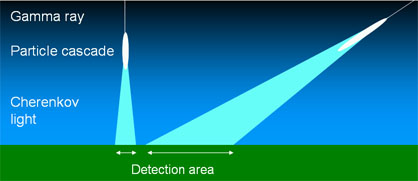
H.E.S.S. observations of Markarian 421 use the large-zenith-angle technique: for gamma rays incident on the atmosphere at large angles (right part of illustration), the particle cascade develops higher up and the Cherenkov light spreads out further and illuminates a larger area on the ground. A telescope anywhere in the “detection area” will see the gamma ray (provided that the intensity of the Cherenkov light is still large enough), resulting in a higher detection rate for very-high-energy gamma rays, compared to vertical incidence.


Markarian 421 was the first extragalactic source of very high energy gamma rays discovered (Punch et al. 1992). It is an active galaxy with a supermassive black hole at its core, emitting a jet of particles pointed towards us (see also PKS 2155-304). At a redshift of 0.03, it is relatively nearby. This source is known to exhibit flaring  activity, where the emission increases by factors up to 100, with year-long quiescent periods in between. The time scale of the flares varies down to 15 min. and below (Gaidos et al. 1996), indicating that the emission region is of a similar scale as the solar system, and that the emission must be driven by processes occurring rather close the central engine of the active galaxy – the black hole. High-energy particles in the jet are believed to be responsible for the gamma-ray emission; since a correlation between the activity in very high energy gamma rays and in X-rays is observed (e.g. Blazejowksi et al. 2005), it is likely that the gamma rays originate from accelerated electrons, generating X-rays by synchrotron radiation and very high energy gamma-rays by upscattering of lower-energy photons, or of the synchrotron-radiation X-rays.
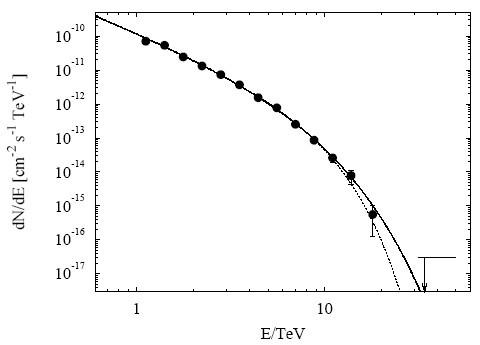
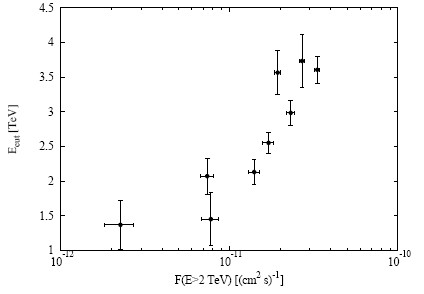
At a declination of 38 degr. N, the northern-hemisphere object Markarian 421 reaches only shallow elevation above ground when viewed from the Namibian H.E.S.S. site (at 23 degr. S); it culminates at an elevation around 30 degr. and has therefore to be observed through a large air mass. What at first sounds like a significant disadvantage has an interesting side effect (top illustration): since the particle cascade generating the Cherenkov light is much further from the telescopes than usual, the light spreads out and covers a much larger area on the ground. The resulting lower intensity of Cherenkov light implies that the energy threshold of the instrument is increased by a factor 10, from about 100 GeV for observations near zenith to about 1 TeV. However, since the Cherenkov light is so spread out, the area over which showers can be detected increases to two square kilometers, with a corresponding gain in detection rates. Observations at low elevations therefore allow one to measure the high-energy part of the spectrum with improved precision (see also Tanimori et al. 1994, Krennrich et al. 1999). The energy spectrum determined with H.E.S.S. (Fig. 1) extends from 1 TeV to well beyond 10 TeV. At the high-energy end, it shows deviations from the usual power-law spectra, indicating that the acceleration process “runs out of steam” or that particles there lose their energy faster – e.g. by synchrotron radiation – than the acceleration mechanism can supply. The energy of the spectral break varies with the gamma-ray flux (Fig. 2); an explanation is that the high-flux states are caused by fresh injection of high-energy particles which then lose their energy, resulting in a reduction of both the gamma-ray flux and the energy of the break. Similar variations were observed in earlier episodes (Krennrich et al. 2002, Aharonian et al. 2002)
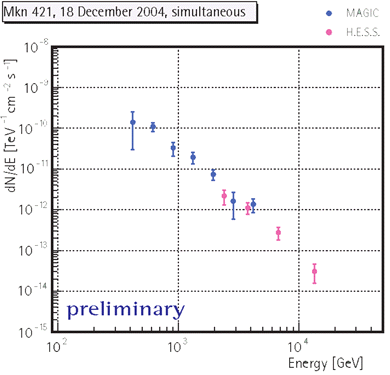
Wide spectral coverage is important to understand and model the processes in the source. An interesting technique to combine results from different observatories was recently explored for the first time: the H.E.S.S. and MAGIC Cherenkov instruments observed Markarian 421 simultaneously, H.E.S.S. at low elevation, covering high energies, and the La Palma based MAGIC instrument at higher elevation, covering the low-energy part of the spectrum (Fig. 3). Such combined observations may ultimately allow to extend spectral coverage of short flares by about one order of magnitude and a joint MAGIC/H.E.S.S. working group has been set up coordinate observations.
In addition to the detection of the well-known object Markarian 421 and the AGN PKS 2155-304 covered earlier, H.E.S.S. has discovered a number of gamma-ray emitting active galaxies at larger distances, which will be featured in this series in the next months.

References:

Observations of Mkn 421 in 2004 with H.E.S.S. at large zenith angles, F. Aharonian et al., Astron. Astrophys. 437 (2005) 95-99 and Concept of a Global Network of Cherenkov Telescopes (GNCT) and first joint observations of H.E.S.S. and MAGIC, D. Mazin et al., 29th Int. Cosmic Ray Conf., Pune, 2005.


Fig. 1: Energy spectrum of Markarian 421 determined from 15 h of observations at large zenith angles. The full curve represents a fit using a power law spectrum with an exponential cutoff at high energy, characterizing the break in the spectrum apparent at high energies.

Fig. 2: Energy of the break energy in the spectrum, as a function of the gamma-ray flux.

Fig. 3: Preliminary spectra measured by MAGIC and H.E.S.S.  in a short simultaneous observation of Markarian 421 in December 2004. The H.E.S.S. data points were obtained from observations at very large zenith angles and cover the high-energy range. (D. Mazin et al., poster at 29th Int. Cosmic Ray Conf., Pune, 2005

Previous articleHESS J1825-137 - a Crushed Pulsar Wind Nebula?Next article PKS 2005-489 - the first new AGN discovered by H.E.S.S.

Sources of the month

Each month a TeV gamma ray source investigated with the H.E.S.S. telescopes is featured. See also the pages on Astrophysics with H.E.S.S.: The Nonthermal Universe with an overview of the physics and the source types.

Latest sources

The Vela Pulsar – the most Highly Energetic ClockNovember 1, 2023
HESS J1645−455 – A gem on the ring?October 1, 2023
The identity crisis of the blazar PKS 1510-089August 1, 2023

Tags

Atmosphere (1) black holes (2) Blazar (1) Cosmic rays (1) Extragalactic (2) Galactic Center (1) galactic plane (3) galactic source (1) Gamma-ray binary (2) gamma-rays (3) neutrinos (1) Nova (1) pulsar (1)

Contact

You can contact us for scientific queries and general information using:
contact.hess@hess-experiment.eu

Data Privacy Statement

https://www.mpi-hd.mpg.de/mpi/de/datenschutzhinweis
H.E.S.S. collaboration official website. Proudly Built By H.E.S.S. members.
(c) 2004-2025 by the H.E.S.S. collaboration

Last sources of the month

The Vela Pulsar – the most Highly Energetic ClockNovember 1, 2023
HESS J1645−455 – A gem on the ring?October 1, 2023
The identity crisis of the blazar PKS 1510-089August 1, 2023

Internal

  • Log in
  • Entries feed
  • Comments feed
  • WordPress.org
H.E.S.S. Collaboration
Manage Consent
To provide the best experiences, we use technologies like cookies to store and/or access device information. Consenting to these technologies will allow us to process data such as browsing behavior or unique IDs on this site. Not consenting or withdrawing consent, may adversely affect certain features and functions.
Functional Always active
The technical storage or access is strictly necessary for the legitimate purpose of enabling the use of a specific service explicitly requested by the subscriber or user, or for the sole purpose of carrying out the transmission of a communication over an electronic communications network.
Preferences
The technical storage or access is necessary for the legitimate purpose of storing preferences that are not requested by the subscriber or user.
Statistics
The technical storage or access that is used exclusively for statistical purposes. The technical storage or access that is used exclusively for anonymous statistical purposes. Without a subpoena, voluntary compliance on the part of your Internet Service Provider, or additional records from a third party, information stored or retrieved for this purpose alone cannot usually be used to identify you.
Marketing
The technical storage or access is required to create user profiles to send advertising, or to track the user on a website or across several websites for similar marketing purposes.
Manage options Manage services Manage {vendor_count} vendors Read more about these purposes
View preferences
{title} {title} {title}