H.E.S.S. CollaborationH.E.S.S. Collaboration
  • About H.E.S.S.
    • H.E.S.S. Collaboration
      • Organisation
    • H.E.S.S. Science
    • H.E.S.S. Telescopes
    • H.E.S.S. Prize
  • News
    • Announcements
    • Press releases
    • Archival news
  • Source of the month
  • For scientists
    • Publications
      • Journals
      • Conferences
      • Astronomers Telegram
    • External Proposals
      • Visibility calculator
    • GRB observation schedule
    • Public test data release
    • Telescope specifications
  • Contact
September 1, 2005 by H.E.S.S. Collaboration
Source of the Month

HESS J1825-137 – a Crushed Pulsar Wind Nebula?

HESS J1825-137 – a Crushed Pulsar Wind Nebula?
September 1, 2005 by H.E.S.S. Collaboration
Source of the Month

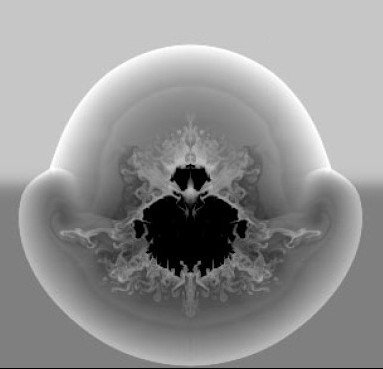
Simulation of a supernova exploding into an inhomogeneous interstellar medium (Blondin et al, 2001). In the less dense regions (bottom), the shock wave (outer contour) propagates faster. At the center is a pulsar left over from the explosion; it generates a relativistic pulsar wind of electrons and positrons, which blows a bubble (black) into the supernova ejecta. At the edge of the bubble, in the pulsar wind termination shock, particles are accelerated, creating a pulsar wind nebula (like the Crab Nebula or MSH 15-52). The size of the pulsar wind bubble  is regulated by the “reverse shock”: when the outgoing supernova shock wave hits the interstellar material, a second shock wave is created, moving backward into the ejecta, and a some point running into the pulsar wind nebula and crushing it. In the simulation shown on the left, the stronger reverse shock from the denser (top) side has already reached and crushed the top half of the pulsar wind nebula, whereas the bottom half of the nebula is still expanding. The net effect is that the pulsar wind nebula appears shifted with respect to the pulsar.


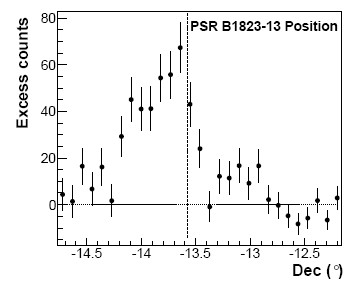
In the H.E.S.S. Galactic Plane Survey (Aharonian et al 2005), a number of new TeV gamma ray sources were discovered in the central region of our Galaxy, among them the source termed HESS J1825-137, located close to the pulsar PSR B1823-13, but not coincident with it (Fig. 1). Initially, it was not at all clear if there was a relation between the TeV source and the pulsar – with its age of about 20000 years (Clifton 1992) and an estimated distance of about 4 kpc (Cordes and Lazio 2002). However, closer inspection of the spatial distribution of TeV gamma rays revealed an asymmetric distribution, peaking at the pulsar and decaying toward the South (Fig. 2), as if the pulsar is emitting a wide beam of particles towards the South. This behavior is remarkably similar to the situation in X-rays, where the pulsar is surrounded by a nebula (Finley et al. 1996) with a pronounced tail towards the south (Gaensler et al. 2003, black contour in Fig. 1), except that the scales are different: the X-ray tail has a characteristic scale of a few arcmin., compared to a fraction of a degree for TeV gamma rays.
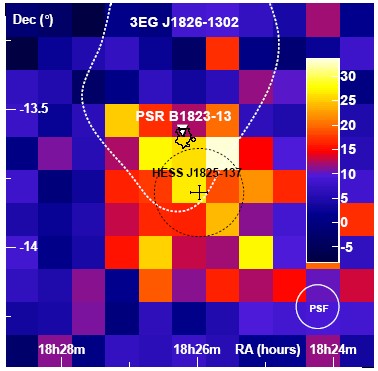
One explanation is that we are seeing a pulsar wind nebula – a nebula generated by the stream of relativistic electrons and positrons from the pulsar – which started out symmetrically from the pulsar, but where one side (the top, North part) was crushed by the reverse shock rebouncing when the supernova shock wave had piled up enough interstellar material to generate a significant pressure (see image and text on top). In case the supernova expanded into an inhomogeneous media, the reverse shock from the (lower-density) south side may not yet have reached the pulsar wind nebula. Such scenarios were modeled by Blondin et al, (2001).
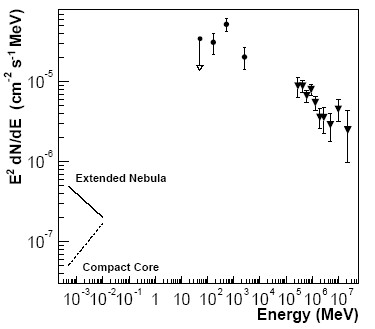
The interpretation raises a number of questions: (i) Why is the X-ray nebula so much smaller than the TeV nebula? A plausible explanation is that given the 10 Microgauss magnetic field estimated for the nebula, the X-rays are emitted by higher-energy electrons than the gamma-rays.  Such high-energy (100 TeV) electrons lose their energy quickly and to not propagate as far. For the same reason, the X-ray energy flux is well below the flux observed in gamma rays (Fig. 3). (ii) Where and how big is the associated supernova shell? So far, it escaped detection. (iii) Why is the pulsar wind nebula so large? Taking the 20000 year estimated age of the pulsar, the supernova must have exploded into a very low-density medium in order to allow the nebula to expand so quickly. Future, more sensitive observations in different wavelength regions should help to unravel the dynamics of this interesting system.
References:

A possible association of the new VHE -ray source HESS J1825–137 with the pulsar wind nebula G18.0–0. , H.E.S.S. collaboration, F. Aharonian et al., submitted to Astronomy & Astrophysics


Fig. 1: TeV emission in a declination band centered around the pulsar, whose position is indicated by the dashed line. The TeV flux peaks just south of the pulsar and then falls off with increasing distance. Given a distance of about 4 kpc of the object, the characteristic (0.5 degr.) size of the emission region corresponds to about 30 pc or 100 light years.

Fig. 2: TeV emission in a declination band centered around the pulsar, whose position is indicated by the dashed line. The TeV flux peaks just south of the pulsar and then falls off with increasing distance. Given a distance of about 4 kpc of the object, the characteristic (0.5 degr.) size of the emission region corresponds to about 30 pc or 100 light years.

Fig. 3: Broadband emission spectra, from X-rays to TeV gamma rays. The quantity plotted, E2dN/dE, corresponds to the energy emitted into each decade of the spectrum. The X-ray emission is relatively faint; the reason could be that the X-rays are generated by higher-energy electrons (~100 TeV) than the gamma rays; since these high-energy electrons lose their energy much more quickly, they have more of less “died out”.

Previous articleVery high energy gamma rays from the microquasar LS 5039Next article Markarian 421 - a Fresh Look at a Familiar Source

Sources of the month

Each month a TeV gamma ray source investigated with the H.E.S.S. telescopes is featured. See also the pages on Astrophysics with H.E.S.S.: The Nonthermal Universe with an overview of the physics and the source types.

Latest sources

The Vela Pulsar – the most Highly Energetic ClockNovember 1, 2023
HESS J1645−455 – A gem on the ring?October 1, 2023
The identity crisis of the blazar PKS 1510-089August 1, 2023

Tags

Atmosphere (1) black holes (2) Blazar (1) Cosmic rays (1) Extragalactic (2) Galactic Center (1) galactic plane (3) galactic source (1) Gamma-ray binary (2) gamma-rays (3) neutrinos (1) Nova (1) pulsar (1)

Contact

You can contact us for scientific queries and general information using:
contact.hess@hess-experiment.eu

Data Privacy Statement

https://www.mpi-hd.mpg.de/mpi/de/datenschutzhinweis
H.E.S.S. collaboration official website. Proudly Built By H.E.S.S. members.
(c) 2004-2025 by the H.E.S.S. collaboration

Last sources of the month

The Vela Pulsar – the most Highly Energetic ClockNovember 1, 2023
HESS J1645−455 – A gem on the ring?October 1, 2023
The identity crisis of the blazar PKS 1510-089August 1, 2023

Internal

  • Log in
  • Entries feed
  • Comments feed
  • WordPress.org
H.E.S.S. Collaboration
Manage Consent
To provide the best experiences, we use technologies like cookies to store and/or access device information. Consenting to these technologies will allow us to process data such as browsing behavior or unique IDs on this site. Not consenting or withdrawing consent, may adversely affect certain features and functions.
Functional Always active
The technical storage or access is strictly necessary for the legitimate purpose of enabling the use of a specific service explicitly requested by the subscriber or user, or for the sole purpose of carrying out the transmission of a communication over an electronic communications network.
Preferences
The technical storage or access is necessary for the legitimate purpose of storing preferences that are not requested by the subscriber or user.
Statistics
The technical storage or access that is used exclusively for statistical purposes. The technical storage or access that is used exclusively for anonymous statistical purposes. Without a subpoena, voluntary compliance on the part of your Internet Service Provider, or additional records from a third party, information stored or retrieved for this purpose alone cannot usually be used to identify you.
Marketing
The technical storage or access is required to create user profiles to send advertising, or to track the user on a website or across several websites for similar marketing purposes.
Manage options Manage services Manage {vendor_count} vendors Read more about these purposes
View preferences
{title} {title} {title}