H.E.S.S. CollaborationH.E.S.S. Collaboration
  • About H.E.S.S.
    • H.E.S.S. Collaboration
      • Organisation
    • H.E.S.S. Science
    • H.E.S.S. Telescopes
    • H.E.S.S. Prize
  • News
    • Announcements
    • Press releases
    • Archival news
  • Source of the month
  • For scientists
    • Publications
      • Journals
      • Conferences
      • Astronomers Telegram
    • External Proposals
      • Visibility calculator
    • GRB observation schedule
    • Public test data release
    • Telescope specifications
  • Contact
August 1, 2005 by H.E.S.S. Collaboration
Source of the Month

Very high energy gamma rays from the microquasar LS 5039

Very high energy gamma rays from the microquasar LS 5039
August 1, 2005 by H.E.S.S. Collaboration
Source of the Month

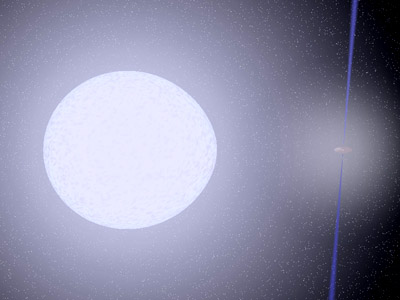
A computer simulation of the microquasar LS5039, showing one possible scenario where gamma rays are generated in microquasar ‘jets’. The companion star to the compact object is a massive star that is losing material from its surface. This matter is then  captured by the compact object’s strong gravitational field and spirals down towards the surface. Some of this material is then ejected in two jets traveling at ~20% of the speed of light.Image generated using software by Rob Hynes (LSU).


“Microquasars” are galactic stellar-mass compact objects – neutrons stars or black holes – which accrete matter. Like in quasars – active galactic nuclei with a supermassive black hole – part of the infalling matter emerges again in form of two relativistic jets, which emit radio waves and X-rays and which might also be able to generate high-energy particles and gamma rays (see e.g. Mirabel & Rodriguez 1999 for a review). The accreted matter is usually provided by a massive star forming a binary system together with the compact object, presumably as a result of a supernova explosion in a double-star system. The study of similarities and differences between microquasars and quasars should shed more light on the processes in these objects.

he binary system LS 5039, at a distance of about 3 kpc, was discovered by Motch et al. 1997, cross-correlating X-ray sources from the ROSAT catalog with OB star catalogues in order to locate systems made of a compact X-ray source orbiting a massive star. Using the VLA radio interferometer, Marti et al. 1998 identified LS 5039 as a nonthermal radio source, supporting the identification. New X-ray observations (Ribo et al. 1999) showed a hard spectrum, but neither pulsed nor periodic emission. Paredes et al. 2000 discovered that the system exhibits radio jets at the milliarcsecond scale; this was confirmed in Paredes et al. 2002. Clark et al. 2001 showed that the mass donor was a O6.5V(f) star. Using radial velocity measurements, McSwain et al. 2001, 2004 succeeded in determining the orbit period to 4.4 days, with an eccentricity of about 0.4. McSwain et al. 2002 suggest, on the basis of the modest X-ray flux, that the compact object accretes matter from the stellar wind of its companion, rather than by direct Roche-lobe overflow. McSwain et al. 004 favors a mass range for the compact object of 1-2 solar masses, a massive companion of 20 to 35 solar masses, and small inclination of the orbit relative to the line of sight. In a recent paper by Casares et al., the orbit period is revised to 3.9 days and based on atmosphere model fitting to the spectrum of the optical companion, a mass of the compact object of about 4 solar masses is estimated, which would point to a black hole rather than a neutron star. LS 5039 is moving with more than 100 km/s perpendicular to the Galactic plane, probably as a result of a recoil generated in the supernova explosion that generated the compact object (Ribo et al. 2002).
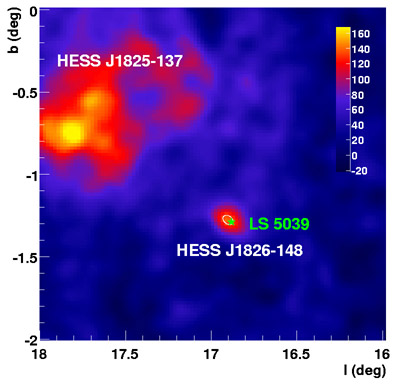
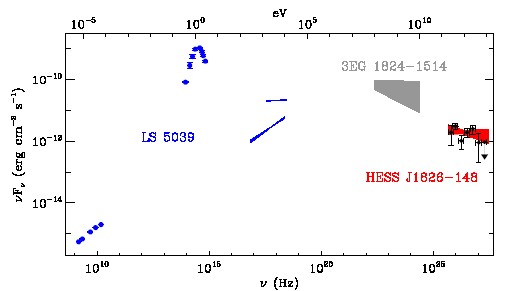
he detection of LS 5039 in very high energy gamma rays by H.E.S.S. (Fig. 1, Fig. 2) provides clear evidence that microquasars are indeed capable of accelerating particles to multi-TeV energies. LS 5039 was initially discovered in the H.E.S.S. survey of the central region of the Galactic plane; follow-up observations were conducted to confirm the result. The photon spectrum is rather hard, with a spectral index of ~2.1 (Fig. 3). The detailed mechanisms how the gamma rays are generated are still under discussion. Possible scenarios include inverse-Compton scattering of photons from the companion star, from the accretion disk, or of synchrotron photons (e.g. Bosch-Ramon et al. 2005, Romero et al. 2003 and earlier references given there). However, the flux of photons from the companion star is so large, that gamma rays produced in the vicinity of the compact object are likely to be absorbed, resulting in production of electron-positron pairs (e.g. Bednarek 1997). If nucleons are accelerated, they ought to be able to carry their energy far enough away before interacting and generating gamma rays. A clue could come from an orbital modulation of the gamma-ray flux according to the 4 day orbital period; more data is being collected to probe the time dependence.
References:

Discovery of VHE gamma-ray emission from the X-ray binary LS 5039, H.E.S.S. collaboration, F. Aharonian et al. (Science Express, preprint, H.E.S.S. press release, see also MPG, CNRS, INSU, PPARC)


Fig. 1: Map of the gamma ray sky in the region of the new gamma ray source LS5039, also termed HESS J1826-148. The green star shows the position of  LS5039 as measured using radio telescopes, and the white ellipse shows the gamma ray position. In the upper-left corner, another H.E.S.S.-discovered gamma ray source is visible, called HESS J1825-137.

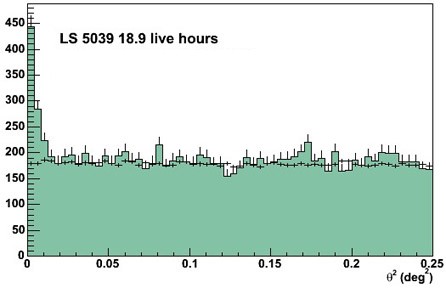
Fig. 2: Gamma-ray signal from LS 5039 based on 18.9 h of data, including newer follow-up observations (preliminary). Shown is the number of gamma-ray candidates as a function of the (squared) angle between the direction of the gamma ray and the source. The full histogram gives the on-source data, the crosses indicate the estimated (flat) background. The significance of the LS 5039 signal is about 16 sigma.

Fig. 3: Wide-band spectral energy distribution for LS 5039 (assuming that the EGRET source 3EG 1824-1514 is also associated the LS 5039). The bump in the visible/near infrared represents radiation from the massive companion star, the other components seem associated with the compact object.

Previous articleHESS J1813-178 -- no longer an unidentified TeV sourceNext article HESS J1825-137 - a Crushed Pulsar Wind Nebula?

Sources of the month

Each month a TeV gamma ray source investigated with the H.E.S.S. telescopes is featured. See also the pages on Astrophysics with H.E.S.S.: The Nonthermal Universe with an overview of the physics and the source types.

Latest sources

The Vela Pulsar – the most Highly Energetic ClockNovember 1, 2023
HESS J1645−455 – A gem on the ring?October 1, 2023
The identity crisis of the blazar PKS 1510-089August 1, 2023

Tags

Atmosphere (1) black holes (2) Blazar (1) Cosmic rays (1) Extragalactic (2) Galactic Center (1) galactic plane (3) galactic source (1) Gamma-ray binary (2) gamma-rays (3) neutrinos (1) Nova (1) pulsar (1)

Contact

You can contact us for scientific queries and general information using:
contact.hess@hess-experiment.eu

Data Privacy Statement

https://www.mpi-hd.mpg.de/mpi/de/datenschutzhinweis
H.E.S.S. collaboration official website. Proudly Built By H.E.S.S. members.
(c) 2004-2025 by the H.E.S.S. collaboration

Last sources of the month

The Vela Pulsar – the most Highly Energetic ClockNovember 1, 2023
HESS J1645−455 – A gem on the ring?October 1, 2023
The identity crisis of the blazar PKS 1510-089August 1, 2023

Internal

  • Log in
  • Entries feed
  • Comments feed
  • WordPress.org
H.E.S.S. Collaboration
Manage Consent
To provide the best experiences, we use technologies like cookies to store and/or access device information. Consenting to these technologies will allow us to process data such as browsing behavior or unique IDs on this site. Not consenting or withdrawing consent, may adversely affect certain features and functions.
Functional Always active
The technical storage or access is strictly necessary for the legitimate purpose of enabling the use of a specific service explicitly requested by the subscriber or user, or for the sole purpose of carrying out the transmission of a communication over an electronic communications network.
Preferences
The technical storage or access is necessary for the legitimate purpose of storing preferences that are not requested by the subscriber or user.
Statistics
The technical storage or access that is used exclusively for statistical purposes. The technical storage or access that is used exclusively for anonymous statistical purposes. Without a subpoena, voluntary compliance on the part of your Internet Service Provider, or additional records from a third party, information stored or retrieved for this purpose alone cannot usually be used to identify you.
Marketing
The technical storage or access is required to create user profiles to send advertising, or to track the user on a website or across several websites for similar marketing purposes.
Manage options Manage services Manage {vendor_count} vendors Read more about these purposes
View preferences
{title} {title} {title}