H.E.S.S. CollaborationH.E.S.S. Collaboration
  • About H.E.S.S.
    • H.E.S.S. Collaboration
      • Organisation
    • H.E.S.S. Science
    • H.E.S.S. Telescopes
    • H.E.S.S. Prize
  • News
    • Announcements
    • Press releases
    • Archival news
  • Source of the month
  • For scientists
    • Publications
      • Journals
      • Conferences
      • Astronomers Telegram
    • External Proposals
      • Visibility calculator
    • GRB observation schedule
    • Public test data release
    • Telescope specifications
  • Contact
July 1, 2005 by H.E.S.S. Collaboration
Source of the Month

HESS J1813-178 — no longer an unidentified TeV source

HESS J1813-178 — no longer an unidentified TeV source
July 1, 2005 by H.E.S.S. Collaboration
Source of the Month

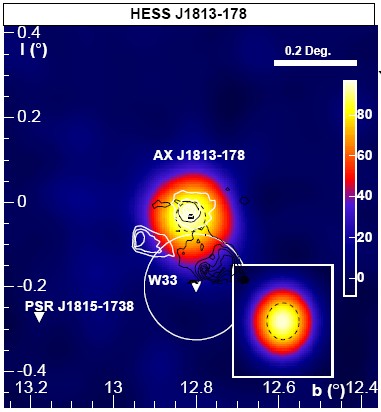
The new TeV gamma-ray source HESS J1813-178 and its surrounding field. The inset illustrates the H.E.S.S. “beam size” governed both by the experimental resolution and a certain amount of smoothing applied to the image. The white contours show the smoothed X-ray count map obtained by the ASCA satellite and the black contours show 20 cm radio emission as observed by the VLA (Brogan et al. 2005).


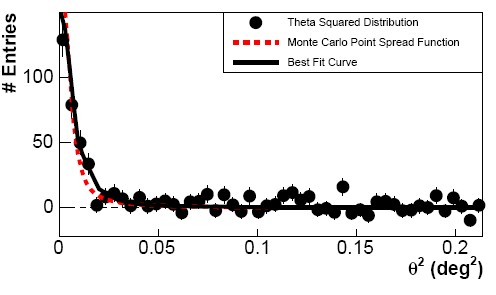
In the survey of the central region of the Milky Way with the H.E.S.S. telescopes (Aharonian et al., 2005, see also here), eight previously unknown sources of very high energy gamma rays were discovered. For two of these sources, HESS J1813-178 and HESS J1614-518, no counterparts in other wavelength regimes were found in the literature. In many sources of high-energy radiation, gamma ray production is related to the acceleration of electrons to high energies. These electrons will emit synchrotron X-rays and radio waves. A source not visible in X-rays or radio could either be a proton accelerator, or be immersed in a rather small magnetic field, reducing losses by synchrotron radiation. Previously, two sources of VHE gamma rays without counterpart were known, the HEGRA-discovered TeV J2032+4130 and HESS J1303-631 . HESS J1813-178 is located within a fraction of a degree from the Galactic plane and is slightly extended, with about 2′ (rms) size (Fig. 1). Therefore, it is most probably a Galactic object. The flux of VHE gamma rays is about 6% of the flux from the Crab nebula, the energy spectrum extends to multi-TeV energies.
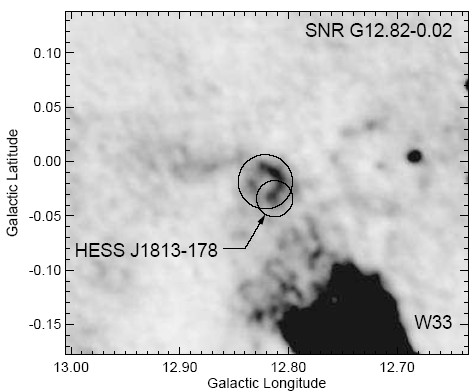
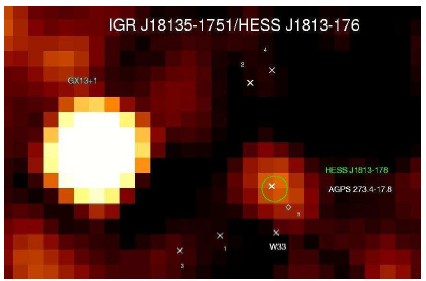
hortly after the discovery of HESS J1813-178 was published, counterparts were located in existing but unpublished multiwavelength data. At the location of HESS J1813-178, X-ray emission is seen in ASCA data (Brogan et al. 2005, Ubertini et al. 2005). The ASCA source is termed AX J1813-178 or also AGPS273.4-17.8, the latter referring to the ASCA scan of the Galactic plane. In radio data, both Brogan et al. (2005) and Helfand et al. (2005) (Fig. 2) located a shell-type supernova remnant where a section of the shell coincides with the gamma-ray source. Finally, data from the INTEGRAL satellite (Ubertini et al. 2005) show in the 20-100 keV range a soft gamma-ray source at the same location (Fig. 3). The distance to the supernova shell is estimated to more than 4 kpc (Brogan et al. 2005), from the size of the shell they estimate an age between 285 and 2500 years. Based on the available data, it is hard to identity the exact source mechanism – particle acceleration in the supernova shock wave as in RXJ 1713.7-3946, or emission from  a pulsar wind nebula such as MSH 15-52 or the Crab Nebula. Ubertini et al. (2005) also speculate about a possible binary system in analogy to the PSR B1259-63/SS2883 system. In either case, HESS J1813-178 is clearly a more or less “classical” TeV source, rather than a “dark accelerator”, as initially thought.
References:

A new population of very high energy gamma-ray sources in the Milky Way, H.E.S.S. collaboration, F. Aharonian et al., Science 307 (2005) 1938-1942and F.A. Aharonian et al., Astrophysical Journal, submitted

Fig. 1: Angular distribution of VHE gamma rays relative to the fitted source position. The red dashed line indicates the experimental resolution, the full black line the best fit obtained for an intrinsic source size of 2′ rms.

Fig. 2: VLA 20 cm radio image of the region of the TeV source HESS J1813-178, showing the TeV source location and the newly discovered supernova remnant G18.82-0.02 (larger circle). The bright HII region W33 is seen at the lower right. From Helfand et al. (2005).

Fig. 3: INTEGRAL 20-100 keV soft gamma-ray image of the source region, with the strong source IGE J18135-1751 and a fainter source coincident with the TeV source, which is indicated as a green circle. From Ubertini et al. (2005).

Previous articleMSH 15-5 2 - a Pulsar Wind Nebula with a JetNext article Very high energy gamma rays from the microquasar LS 5039

Sources of the month

Each month a TeV gamma ray source investigated with the H.E.S.S. telescopes is featured. See also the pages on Astrophysics with H.E.S.S.: The Nonthermal Universe with an overview of the physics and the source types.

Latest sources

The Vela Pulsar – the most Highly Energetic ClockNovember 1, 2023
HESS J1645−455 – A gem on the ring?October 1, 2023
The identity crisis of the blazar PKS 1510-089August 1, 2023

Tags

Atmosphere (1) black holes (2) Blazar (1) Cosmic rays (1) Extragalactic (2) Galactic Center (1) galactic plane (3) galactic source (1) Gamma-ray binary (2) gamma-rays (3) neutrinos (1) Nova (1) pulsar (1)

Contact

You can contact us for scientific queries and general information using:
contact.hess@hess-experiment.eu

Data Privacy Statement

https://www.mpi-hd.mpg.de/mpi/de/datenschutzhinweis
H.E.S.S. collaboration official website. Proudly Built By H.E.S.S. members.
(c) 2004-2025 by the H.E.S.S. collaboration

Last sources of the month

The Vela Pulsar – the most Highly Energetic ClockNovember 1, 2023
HESS J1645−455 – A gem on the ring?October 1, 2023
The identity crisis of the blazar PKS 1510-089August 1, 2023

Internal

  • Log in
  • Entries feed
  • Comments feed
  • WordPress.org
H.E.S.S. Collaboration
Manage Consent
To provide the best experiences, we use technologies like cookies to store and/or access device information. Consenting to these technologies will allow us to process data such as browsing behavior or unique IDs on this site. Not consenting or withdrawing consent, may adversely affect certain features and functions.
Functional Always active
The technical storage or access is strictly necessary for the legitimate purpose of enabling the use of a specific service explicitly requested by the subscriber or user, or for the sole purpose of carrying out the transmission of a communication over an electronic communications network.
Preferences
The technical storage or access is necessary for the legitimate purpose of storing preferences that are not requested by the subscriber or user.
Statistics
The technical storage or access that is used exclusively for statistical purposes. The technical storage or access that is used exclusively for anonymous statistical purposes. Without a subpoena, voluntary compliance on the part of your Internet Service Provider, or additional records from a third party, information stored or retrieved for this purpose alone cannot usually be used to identify you.
Marketing
The technical storage or access is required to create user profiles to send advertising, or to track the user on a website or across several websites for similar marketing purposes.
Manage options Manage services Manage {vendor_count} vendors Read more about these purposes
View preferences
{title} {title} {title}