
H.E.S.S. CollaborationH.E.S.S. Collaboration
  • About H.E.S.S.
    • H.E.S.S. Collaboration
      • Organisation
    • H.E.S.S. Science
    • H.E.S.S. Telescopes
    • H.E.S.S. Prize
  • News
    • Announcements
    • Press releases
    • Archival news
  • Source of the month
  • For scientists
    • Publications
      • Journals
      • Conferences
      • Astronomers Telegram
    • External Proposals
      • Visibility calculator
    • GRB observation schedule
    • Public test data release
    • Telescope specifications
  • Contact
June 1, 2005 by H.E.S.S. Collaboration
Source of the Month

MSH 15-5 2 – a Pulsar Wind Nebula with a Jet

MSH 15-5 2 – a Pulsar Wind Nebula with a Jet
June 1, 2005 by H.E.S.S. Collaboration
Source of the Month

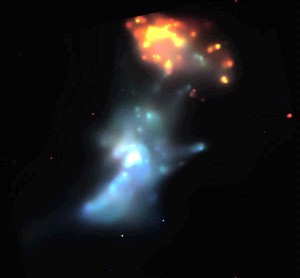
Chandra X-ray image (Gaensler et al. 2002) of the region around the MSH 15-5 2 remnant (also known as G320.4-1.2). At the center the 150 ms X-ray, gamma and radio pulsar PSR B1509-58, surrounded by an X-ray nebula, from which a jet appears to emerge. The structure in the upper half of the image, also known as the optical nebula RCW 89, forms part of the supernova shell, which is better visible in radio images.


The supernova remnant MSH 15-5 2 was first discovered in radio observations, and forms a rather complex object. Radio observations (Caswell et al. 1981) reveal a roughly circular supernova shell 30′ in diameter with a bright feature in the North-West rim and a fainter one in the South-East. A the center of the shell, Seward & Harnden (1982) discovered a 150 ms X-ray pulsar, termed PSR B1509-58, obviously left over after the supernova explosion. The age of the pulsar is estimated to about 2000 years; it is roughly 5 kpc away from Earth. The pulsar is surrounded by a diffuse nebula of unpulsed X-ray emission, clearly seen in ROSAT observations (Trussoni et al. 1996). This pulsar wind nebula is generated by electrons accelerated in the vicinity of the pulsar, streaming away and generating a “pulsar wind termination shock”, similar to what is observed in the Crab nebula.The ROSAT data already hinted a jet-like structure emerging from the pulsar, beautifully confirmed by Chandra data (see image above by Gaensler et al. 2002). In addition to this collimated outflow – most likely along the pulsar spin axis – the image shows arc-like structures North of the pulsar. Interpreted as synchrotron emission from electrons, the X-ray results suggest the presence of electrons accelerated up to energies of tens of TeV, possibly leading to VHE -ray emission through an inverse Compton (IC) process (du Plessis et al. 1995). Early observations with the CANGAROO telescope (Sako et al. 2000) yielded a marginal TeV gamma-ray signal.
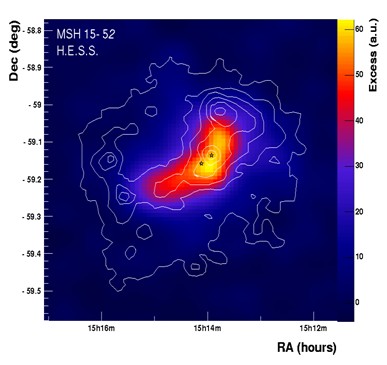
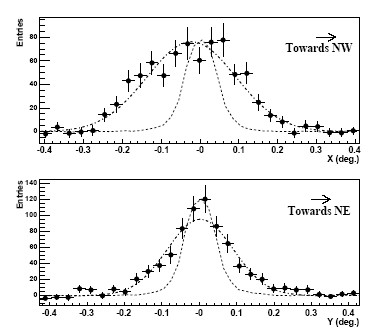
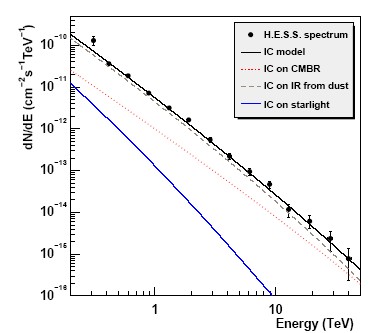
With the H.E.S.S. four-telescope system, 22 h of data were accumulated on MSH 15-5 2, showing a very clear TeV gamma-ray signal with a significance of 25 sigma and a flux of roughly 15% of the flux observed for the Crab Nebula. A surprise was that the TeV gamma rays show a clearly resolved structure (Fig. 1), with an elongated and slightly curved emission region, resembling in its morphology the X-ray jet. In the north-west direction, the source has a characteristic width of 6′ (assuming a Gaussian source profile) (Fig. 2), in the orthogonal direction a width of about 2′, The center of gravity of the gamma-ray emission is displaced from the pulsar. The lack of symmetry, both in the X-rays and gamma rays, implies either a single-sided outflow from the pulsar, or could be the result of beaming in two jets, which suppresses emission from a possible counterjet; however, the mechanisms responsible for the emission of a high-speed jet (or jets) from the pulsar are not understood. The fact that the overall morphology is similar in X-rays and gamma rays demonstrates that the features seen in X-rays reflect the distribution of high-energy electrons rather than a peculiar structure of magnetic fields. X-ray and gamma-ray spectra can be described as resulting from a single population of electrons, radiating in a 17 microGauss magnetic field and scattering infrared photons and starlight photons to TeV energies in the Inverse Compton process (Fig. 3). Obviously, MSH 15-5 2 provides an ideal laboratory for study of the complex processes in the vicinity of pulsars, and their interaction with the ambient medium and radiation fields.
References:

Discovery of extended VHE gamma-ray emission from the asymmetric pulsar wind nebula in MSH 15-5 2 with H.E.S.S, H.E.S.S. collaboration, F. Aharonian et al., Astron. Astrophys. 435 (2005) L17-L20
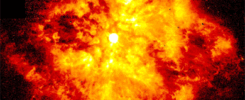
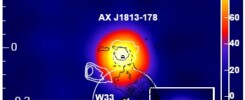
Fig. 1: Smoothed TeV gamma-ray map of MSH 15-5 2 as seen with H.E.S.S.. The white contours indicate the X-ray flux (Trussoni et al. 1996). The upper star shows the location of the pulsar, the lower the center of gravity of the TeV gamma-ray emission.

Fig. 2: Profile of the TeV gamma-ray emission along the North-West direction (along the jet axis) and along the perpendicular North-East direction. The TeV emission profile is wider than the instrumental resolution (narrow dotted peaks), and appears shifted with respect to the pulsar.

Fig. 3: The energy spectrum of gamma rays follows a power law, dN/dE ~ E-2.27, over two decades in energy. The lines show a model fit to the X-ray and TeV gamma-ray data, where electrons generate X-rays by synchrotron radiation in a 17 microGauss magnetic field, and gamma rays by upscattering of infrared photons emitted from interstellar and of starlight photons.

Previous articleHESS J1303-631 - the mystery TeV sourceNext article HESS J1813-178 -- no longer an unidentified TeV source

Sources of the month

Each month a TeV gamma ray source investigated with the H.E.S.S. telescopes is featured. See also the pages on Astrophysics with H.E.S.S.: The Nonthermal Universe with an overview of the physics and the source types.

Latest sources

The Vela Pulsar – the most Highly Energetic ClockNovember 1, 2023
HESS J1645−455 – A gem on the ring?October 1, 2023
The identity crisis of the blazar PKS 1510-089August 1, 2023

Tags

Atmosphere (1) black holes (2) Blazar (1) Cosmic rays (1) Extragalactic (2) Galactic Center (1) galactic plane (3) galactic source (1) Gamma-ray binary (2) gamma-rays (3) neutrinos (1) Nova (1) pulsar (1)

Contact

You can contact us for scientific queries and general information using:
contact.hess@hess-experiment.eu

Data Privacy Statement

https://www.mpi-hd.mpg.de/mpi/de/datenschutzhinweis
H.E.S.S. collaboration official website. Proudly Built By H.E.S.S. members.
(c) 2004-2025 by the H.E.S.S. collaboration

Last sources of the month

The Vela Pulsar – the most Highly Energetic ClockNovember 1, 2023
HESS J1645−455 – A gem on the ring?October 1, 2023
The identity crisis of the blazar PKS 1510-089August 1, 2023

Internal

  • Log in
  • Entries feed
  • Comments feed
  • WordPress.org
H.E.S.S. Collaboration
Manage Consent
To provide the best experiences, we use technologies like cookies to store and/or access device information. Consenting to these technologies will allow us to process data such as browsing behavior or unique IDs on this site. Not consenting or withdrawing consent, may adversely affect certain features and functions.
Functional Always active
The technical storage or access is strictly necessary for the legitimate purpose of enabling the use of a specific service explicitly requested by the subscriber or user, or for the sole purpose of carrying out the transmission of a communication over an electronic communications network.
Preferences
The technical storage or access is necessary for the legitimate purpose of storing preferences that are not requested by the subscriber or user.
Statistics
The technical storage or access that is used exclusively for statistical purposes. The technical storage or access that is used exclusively for anonymous statistical purposes. Without a subpoena, voluntary compliance on the part of your Internet Service Provider, or additional records from a third party, information stored or retrieved for this purpose alone cannot usually be used to identify you.
Marketing
The technical storage or access is required to create user profiles to send advertising, or to track the user on a website or across several websites for similar marketing purposes.
Manage options Manage services Manage {vendor_count} vendors Read more about these purposes
View preferences
{title} {title} {title}